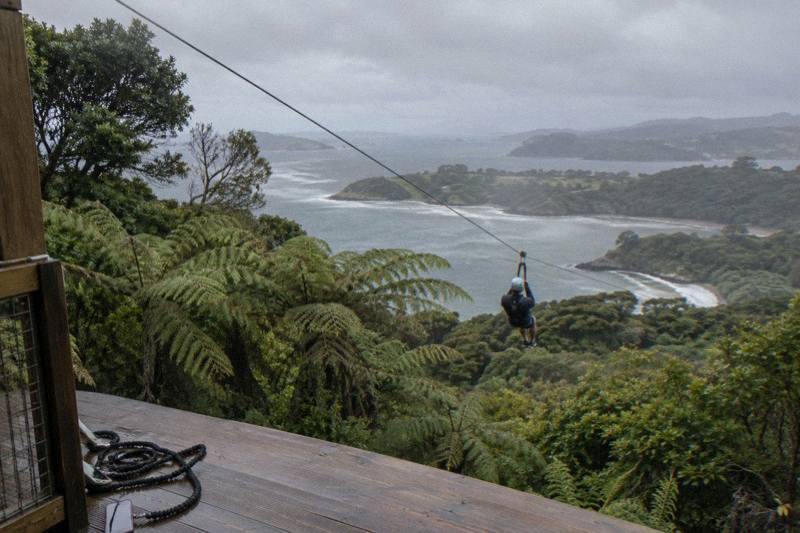
Is The Waiheke Zipline Safe? Operator, Rules And Record
Ziplining carries real risk, and anyone telling you otherwise is selling something. Here is what is verifiably true about the safety systems, rules and oversight behind Waiheke's zipline courses, and where the honest gaps in the record sit.
Short answer
Waiheke's main zipline operator, EcoZip Adventures, holds AdventureMark adventure-activity accreditation, has been safety-registered since 2012, and runs ZipStop braking with backup systems on hardware inspected daily, weekly and monthly. Riders must weigh 30-125 kg. Ziplining is not risk-free, and no incident record for any Waiheke course has been published.
The question "is ziplining safe" deserves a straighter answer than a brochure gives. Ziplining is an adventure activity in which a harnessed person travels at speed along a cable above the ground, and like every such activity it carries real risk that cannot be engineered to zero. What can be checked is the operator's accreditation, the equipment and braking systems in use, the rules that filter who rides, and what injury research says about the activity as a whole. This page works through each of those for Waiheke specifically, using only verifiable sources, and it names the gaps honestly: no operator on the island publishes an incident record, so this page does not claim one.
Who Operates The Waiheke Ziplines And Are They Accredited?
Waiheke has two zipline experiences. EcoZip Adventures runs three dual-cable lines of roughly 200 m each from Trig Hill, and holds AdventureMark adventure-activity accreditation through Quality Standards International, safety-registered since 2012. Man O' War Vineyards runs a separate three-line Forest Flight course over 900 m on its eastern-end property, and this page makes no audit claim for it, because none is sourced.
Accreditation is not a marketing badge in New Zealand, it is a legal requirement. Under the Health and Safety at Work (Adventure Activities) Regulations 2016, commercial zipline operators must pass a safety audit and register with WorkSafe NZ before taking paying customers. WorkSafe published Safety Audit Standard version 2.0, effective 1 April 2024, which sets out the safety management system requirements an operator must meet to stay registered. EcoZip states on its own safety page that it is AdventureMark accredited and has been registered since 2012, more than a decade before the tightened standard came into force.
AdventureMark itself is a JAS-ANZ accredited, WorkSafe-approved certification body operating under New Zealand's Adventure Activities Certification Scheme, and it certifies zipline operators among other adventure businesses. That is the chain of assurance in plain terms: the regulator sets the standard, an accredited certifier audits against it, and the operator must hold current registration to trade. When you book through Waiheke Zipline Tours, the flagship product is the EcoZip experience, precisely because its accreditation trail is documented end to end.
What accreditation does not do is make the activity safe in an absolute sense. It means systems, staff training and equipment are audited against a national standard. A certificate on a wall does not weigh you at check-in, does not check your harness fit, and does not decide whether the wind is too strong on a given Tuesday. Those tasks fall to guides and staff on the day, working inside the audited system. The rest of this page covers what sits underneath that badge, and where you still carry personal responsibility, starting with the hardware.
What Braking And Equipment Systems Do The Lines Use?
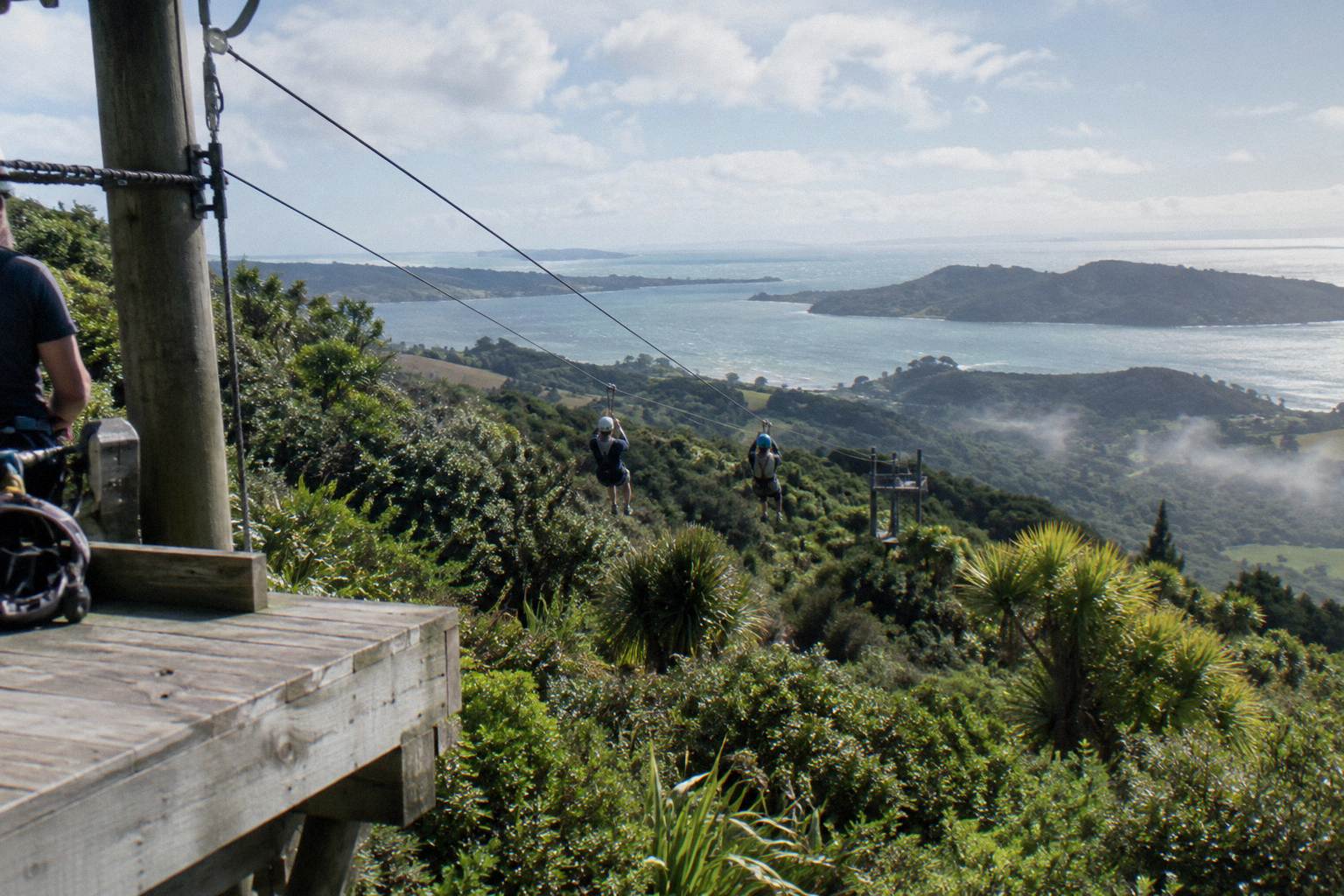
EcoZip's three lines use ZipStop braking with backup systems, and all hardware is inspected on daily, weekly and monthly cycles, according to the operator's own safety documentation. Beyond that, the Waiheke courses use dual or tandem line setups, meaning two people can fly side by side on parallel cables rather than one cable carrying a queue of riders.
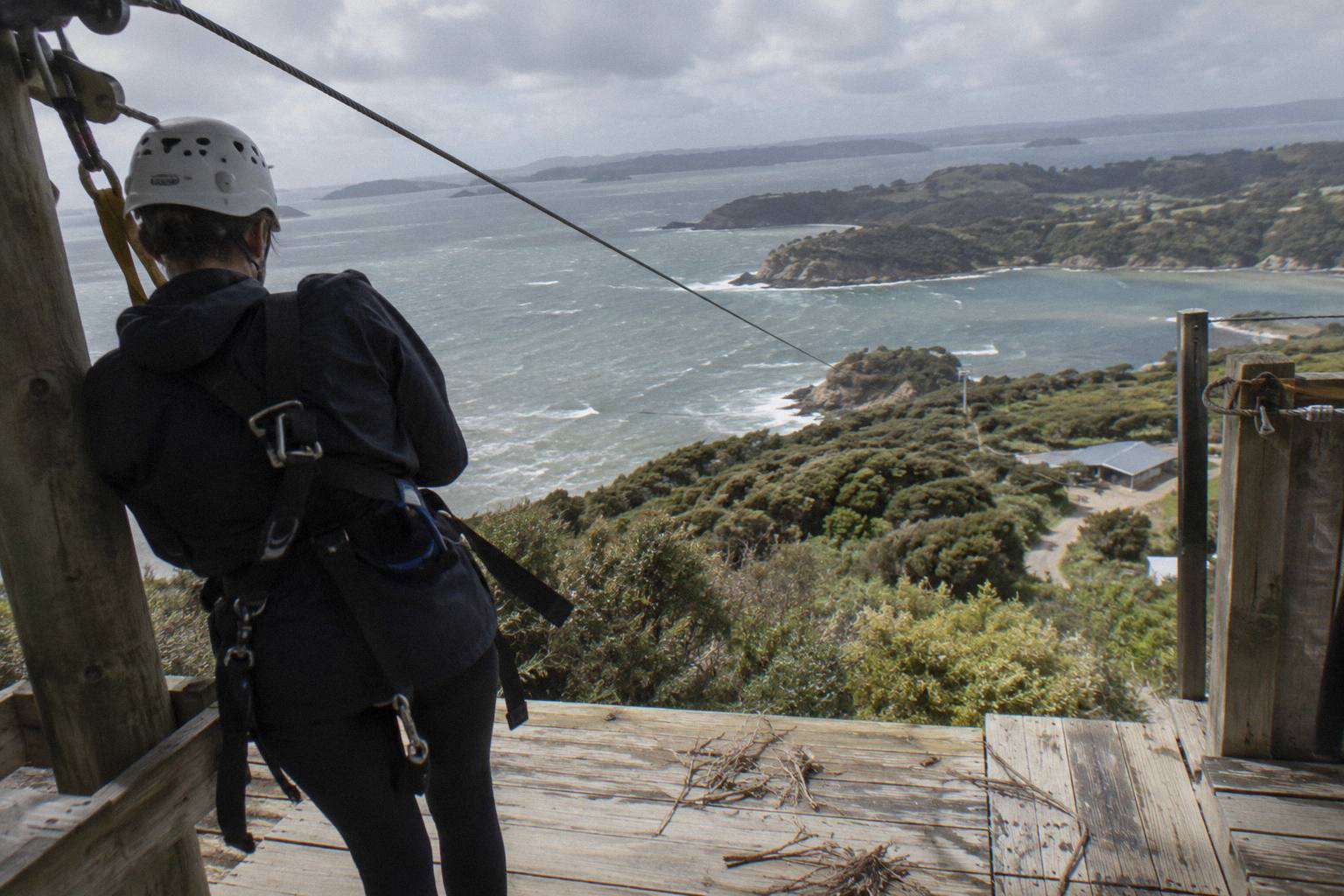
Modern commercial zipline braking works on redundancy. A well-designed system pairs a primary brake with an independent emergency arrest device that engages automatically if the primary fails, so a rider who arrives at the landing platform is slowed twice over. Industry standards make this explicit: the ASTM F2959 standard practice for aerial adventure courses covers design, installation, operation, maintenance and auditing of ziplines, and the ANSI/ACCT challenge course and canopy tour standards require brake systems designed and tested for the extremes of participant weight and arrival speed. EcoZip's stated ZipStop-plus-backup arrangement is the standard architecture those documents describe.
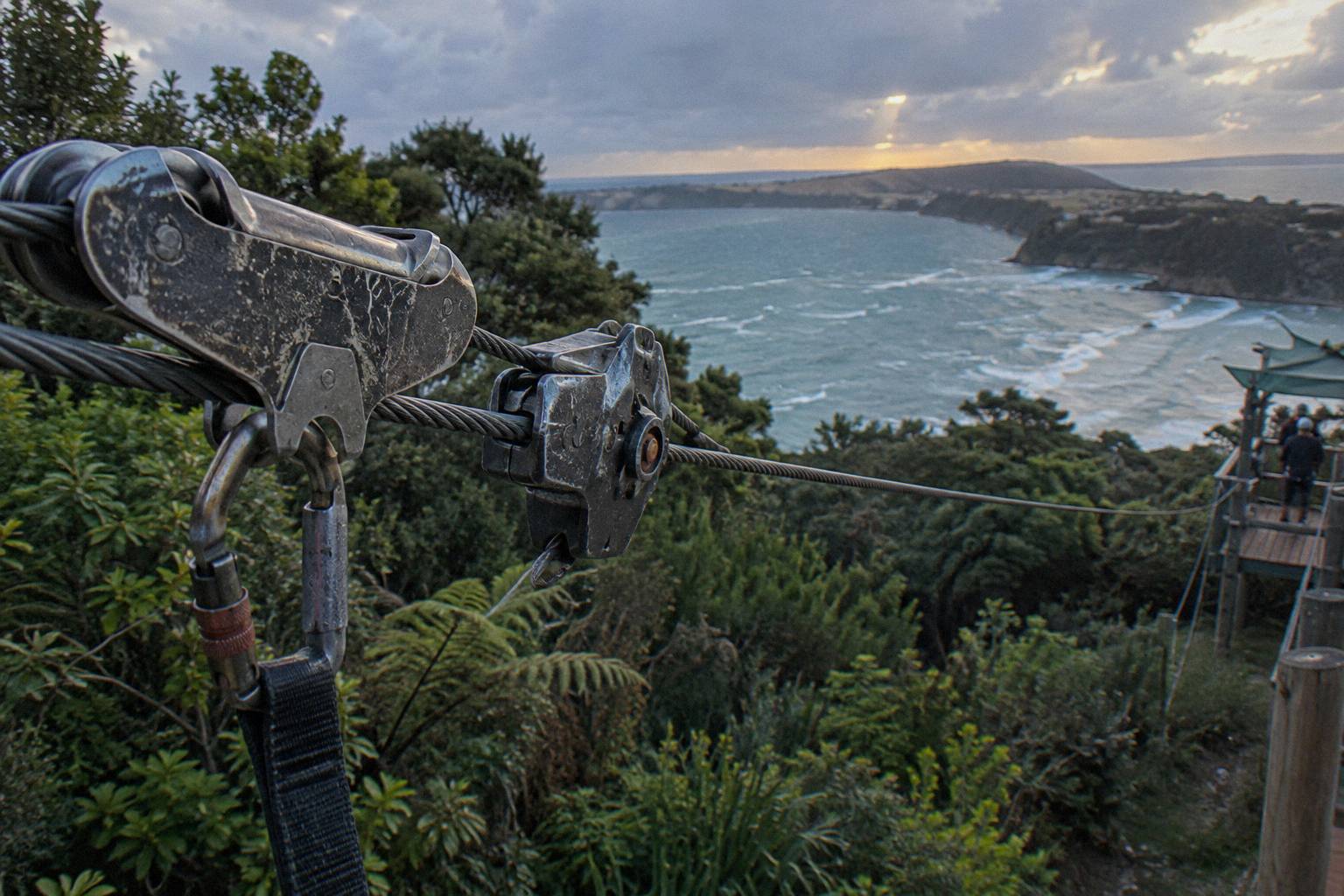
Here is the honest part: inspection schedules and brake architecture are the operator's claims about its own operation. They are plausible, they match industry practice, and they sit inside an audited safety management system, but a reader should know the difference between an external audit and a self-description. The daily, weekly and monthly inspection claim comes from EcoZip's safety page; the AdventureMark accreditation is the external check that such systems exist and are documented.
The dual-cable layout is worth a sentence of its own, because it changes the social physics of the trip as much as the engineering. With two parallel lines, a nervous rider can fly alongside a friend or family member rather than alone, and the guides can send pairs in a controlled sequence instead of stacking riders on one cable. It is one of the small design choices that makes Waiheke's course feel manageable for first-timers without any compromise in the underlying safety architecture.
| Safety layer | What it is on the Waiheke courses | Who verifies it |
|---|---|---|
| Operator registration | Adventure activity registration with WorkSafe NZ, required by law | WorkSafe NZ |
| Safety audit | AdventureMark audit against the Safety Audit Standard (v2.0, effective 1 April 2024) | AdventureMark, a JAS-ANZ accredited certifier |
| Braking | ZipStop primary braking plus backup systems on EcoZip's lines | Operator, within the audited system |
| Hardware inspection | Daily, weekly and monthly inspection cycles | Operator, within the audited system |
| Line configuration | Dual side-by-side cables (EcoZip) or tandem lines (Man O' War) | Operator design |
| Staffing | Up to 12 guests with 2 guides on EcoZip trips | Operator, within the audited system |
If you are weighing which zipline product to book, the three below are the island's core options: the flagship EcoZip zipline and forest walk, its sibling adventure trip with a phone bungee included, and the vineyard-integrated Man O' War Forest Flight.
Safety questions cluster around a handful of practical filters before anyone leaves the platform, and those are worth a section of their own, because they are the part you personally control.
What Are The Weight, Age And Health Rules?
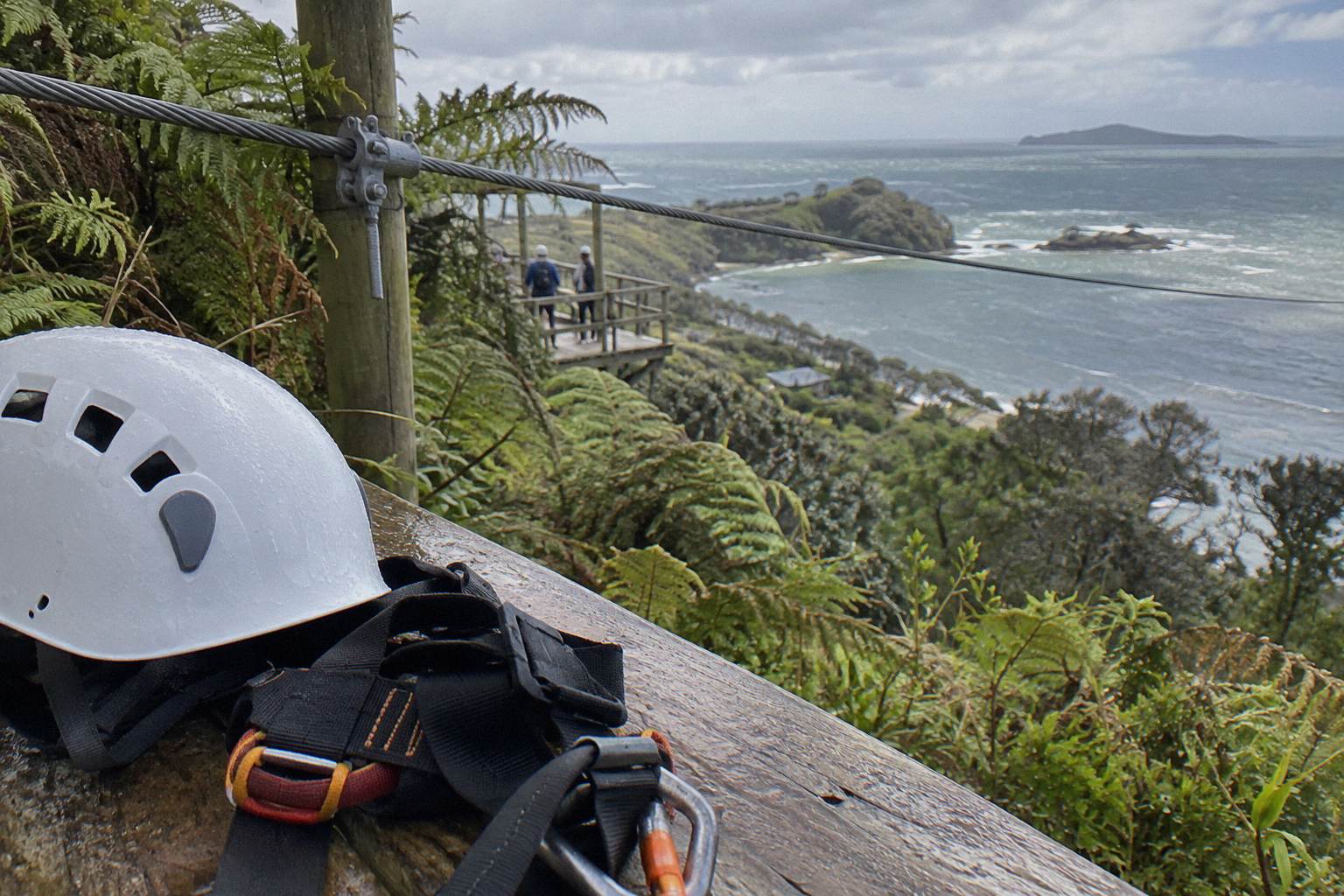
EcoZip requires riders to weigh at least 30 kg and no more than 125 kg, with everyone weighed discreetly at check-in and no automatic refund for being outside the range. There is no age limit, but under-18s need a parent or guardian to agree to the booking terms and sign the risk disclosure form. The operator also lists health conditions that may impair safe participation.
Weight limits on ziplines are engineering, not judgement. Riders below the minimum may not generate enough momentum to reach the braking zone reliably; riders above the maximum risk arriving too fast and overloading the harness, trolley and brake ratings. Generic commercial limits commonly sit around 23-125 kg, and across New Zealand operators the maxima cluster at 120-125 kg, so EcoZip's 125 kg ceiling is typical rather than restrictive. Our dedicated page on Waiheke zipline weight limits and harness sizes works through the numbers in more detail.
The health conditions EcoZip lists include high blood pressure, cardiac conditions, pregnancy, and back or neck injury, and the operator may refuse anyone affected by alcohol or drugs. That list matches the contraindications other New Zealand operators publish, and it exists because harness pressure and sudden deceleration interact badly with certain conditions. Riders with a chronic or recent condition are advised to raise it at booking and consult a doctor where relevant. Separate guides cover whether you can zipline on Waiheke while pregnant and who should not go zip lining condition by condition.
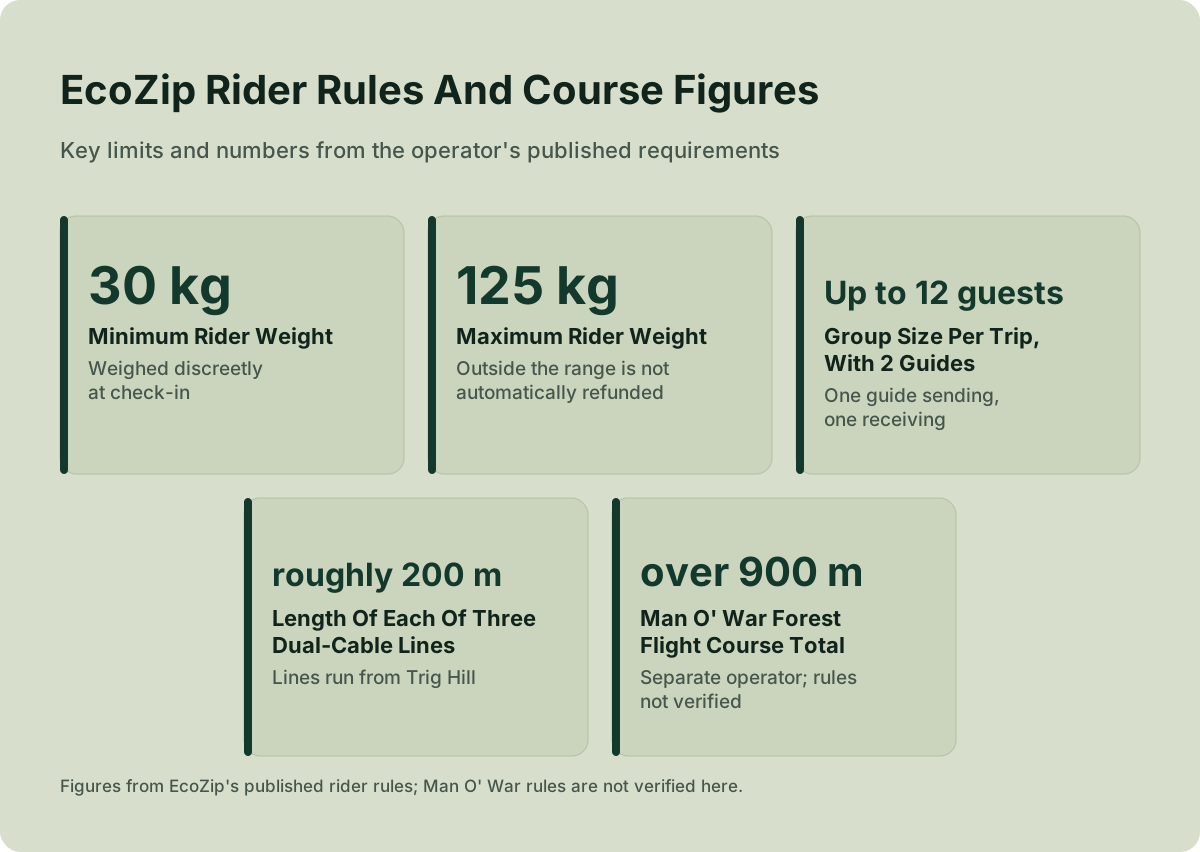
| Rule category | EcoZip requirement | Notes |
|---|---|---|
| Minimum weight | 30 kg (66 lb) | Weighed discreetly at check-in |
| Maximum weight | 125 kg (275 lb) | Over or under the range is not automatically refunded |
| Age | No limit | Under-18s need a guardian to sign the risk disclosure form |
| Child pricing | Ages 15 and under | Family rate is 2 adults + 2 children, or 1 adult + 3 children |
| Group size | Up to 12 guests, 2 guides | Small-group format on every trip |
| Health declarations | High blood pressure, cardiac conditions, pregnancy, back or neck injury | Operator may refuse riders affected by alcohol or drugs |
The Man O' War Forest Flight course sits at the island's eastern end and runs three tandem ziplines totalling over 900 m, connected by 660 m of elevated boardwalk through regenerating kauri forest. Its listing gives the same 30 to 125 kg weight range, while age and cancellation terms are on the live listing, so treat the EcoZip table above as applying to EcoZip only.
How Does The Guided Format Reduce Risk?
Every EcoZip trip runs with two guides for up to twelve guests, a ratio that puts one guide on sending and one on receiving, and the entire experience is guided rather than self-serve: the forest walk after the lines is compulsory even though its commentary is optional.
The two-guide model matters more than it sounds. On a zipline, the two moments that demand supervision are launch and landing, and a dedicated guide at each end means nobody flies until the landing platform confirms it is clear. That is the same logic the industry standards encode in their operational requirements, and it is the reason group size is capped rather than pumped for volume. Twelve guests is the ceiling, not a target.
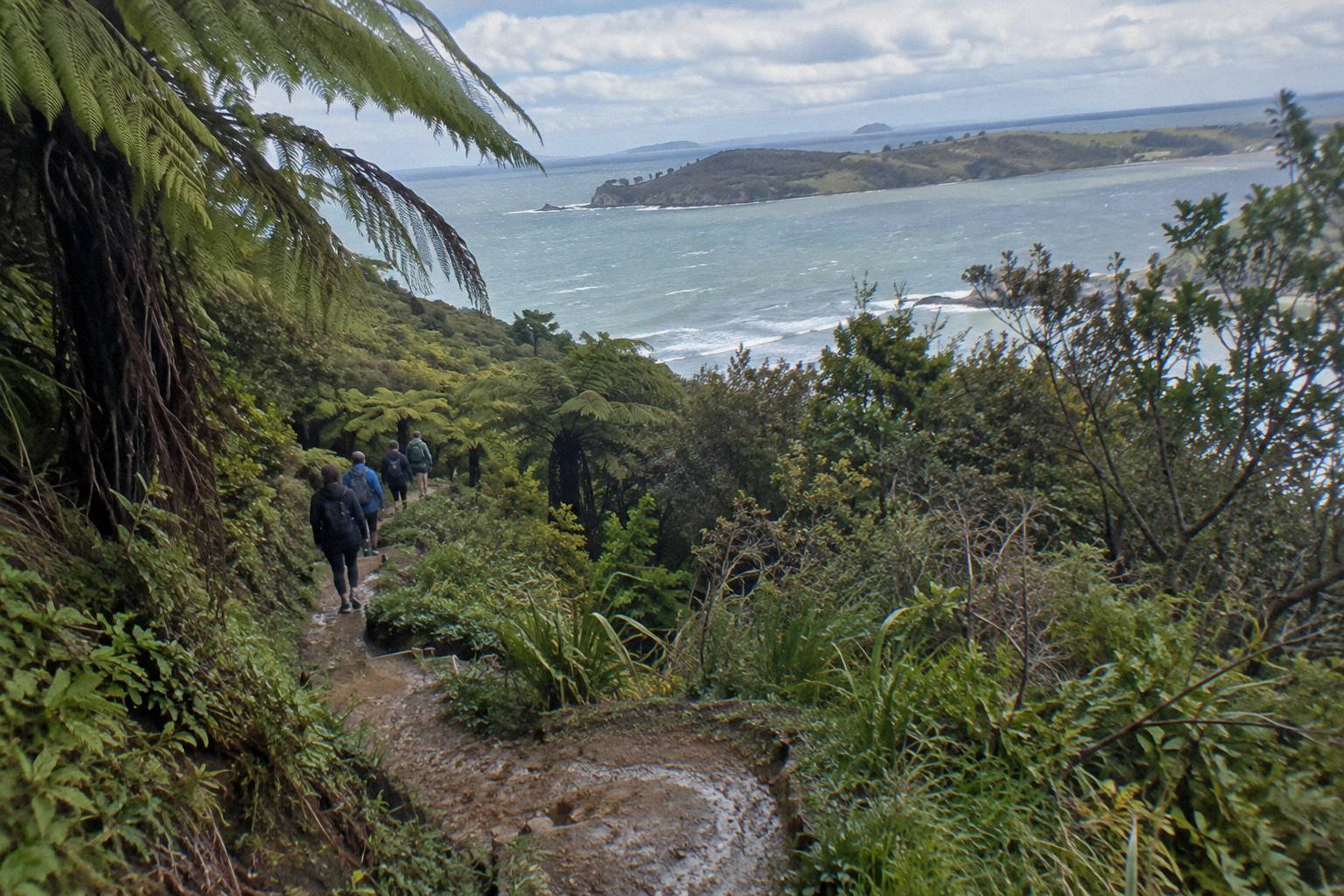
The forest walk deserves an honest mention in a safety discussion, because it is the part people underestimate. It runs about 1.4-1.5 km over uneven ground with switchbacks and a few steady uphill stretches, and it can be muddy after rain. Reasonable fitness is needed, and the walk is not optional even though the guided commentary on it is. If mobility is a concern, read our page on Waiheke zipline accessibility and mobility before booking, as the walk is a fixed component of the experience.
Briefings also cover behaviour on the lines: riders are told not to grab the cable with their hands, to use the designated hand positions, and to follow the braking and leg-positioning instructions given on the day. Phones and cameras must be strapped to clothing or the harness, and EcoZip hands out free phone bungees at check-in. Closed, laced or buckled shoes are required, no jandals, and our fuller rundown lives in the guide to what to wear ziplining on Waiheke.
What Do Injury Statistics Actually Show About Ziplining?
Injury data for ziplining comes mainly from the United States, and it should be read as US figures, not Waiheke ones. A study of US emergency department records covering 1997-2012 estimated 16,850 zipline-related injuries in that period, with falls accounting for 77.3% of them, fractures making up 46.7%, and the upper extremities the most commonly injured body region at 44.1%.
Those numbers sound alarming in isolation and tame in context: 16,850 injuries spread across sixteen years of US zipline operations, an era in which the industry expanded rapidly. The same research stream estimates that lower extremity injuries treated in US emergency departments from 2000 to 2024 totalled around 7,962, about 17.1% of all zipline injuries in that window. The dominant mechanism is falling, not collision or equipment failure, which is consistent with why operators obsess over harness fit, weight ranges and briefing compliance: those are the controls aimed at the dominant injury cause.
| US emergency department measure | Figure | Period |
|---|---|---|
| Estimated total zipline injuries | 16,850 | 1997-2012 |
| Injuries caused by falls | 77.3% of cases | 1997-2012 |
| Fractures | 46.7% of injuries | 1997-2012 |
| Upper extremity as injured region | 44.1% of cases | 1997-2012 |
| Lower extremity injuries | 7,962 estimated | 2000-2024 |
Two things this page will not do with those numbers. It will not scale them down to Waiheke's two courses and call the result a local risk estimate, because no such transfer is valid. And it will not claim any Waiheke incident record, favourable or otherwise, because none has been published. What the US data does support is the plain statement that ziplining injures people sometimes, that the injuries are mostly fall-related, and that the safety architecture described in the sections above, from harness checks to braking redundancy, is aimed squarely at that failure mode. For a wider look at the rare end of the risk spectrum, see our post on the fatality rate for ziplining.
The Boutique Experience cellar tour from The Wine Tasting Company, rated 5.0 from 91 reviews, is a popular low-intensity pairing for travellers who want the island's wine side without adding a second aerial activity to the day.
What Happens In Wind, Rain Or Bad Weather?
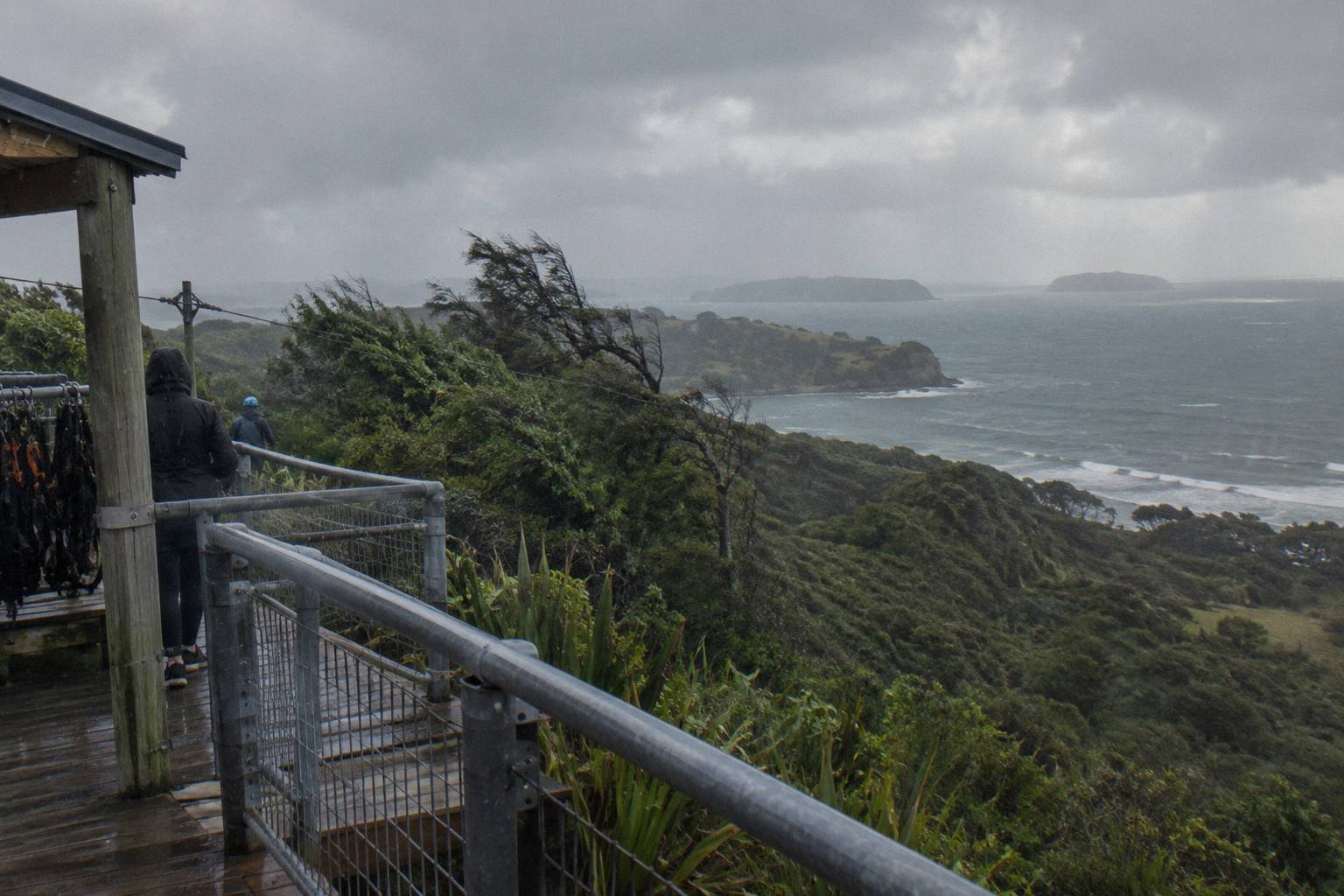
EcoZip runs in rain and cancels only when wind is consistently above 35 knots, offering a date or time change or a full refund when it does. Wind, not rain, is the operational cutoff, and the decision sits with the operator's staff on the day.
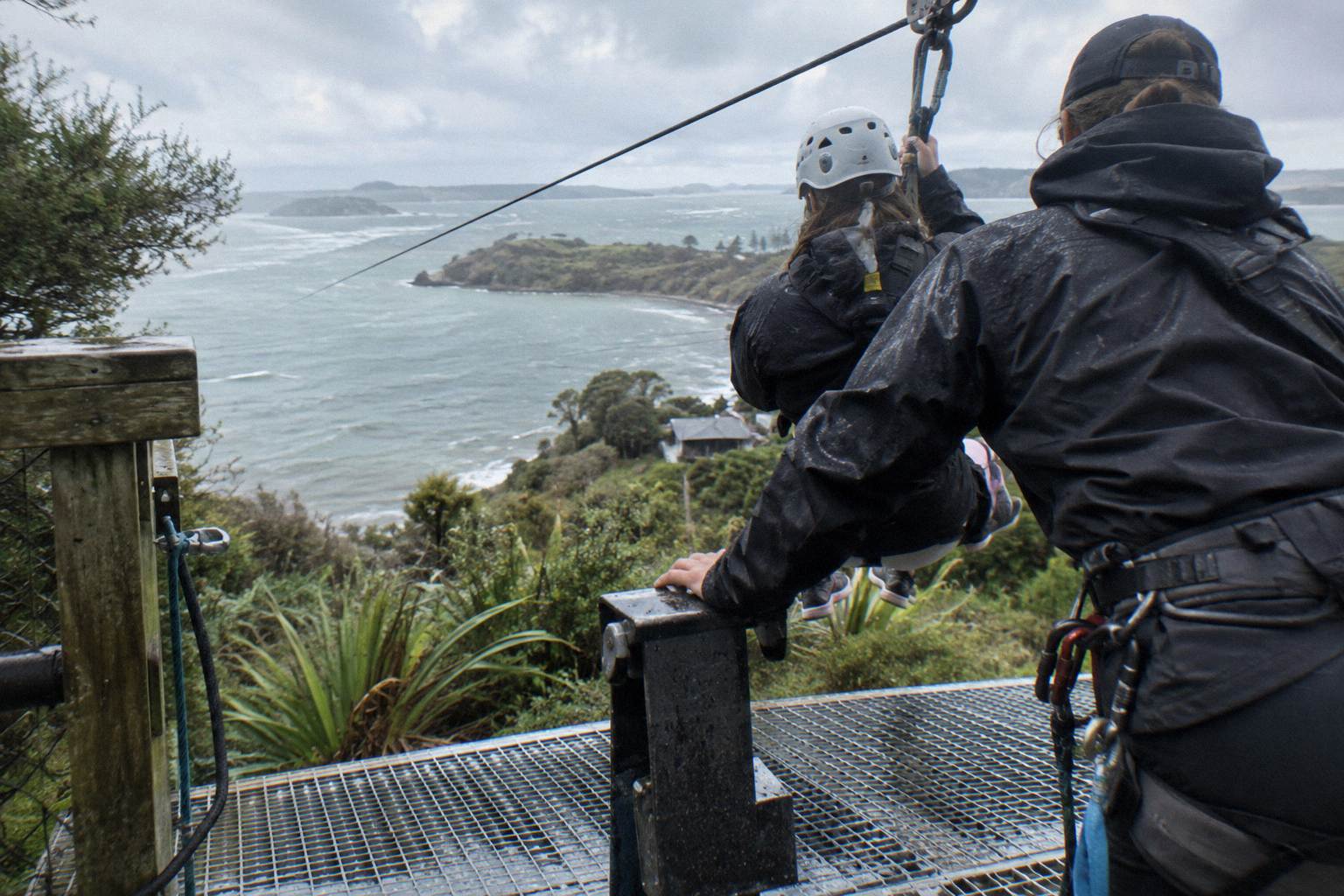
The 35-knot threshold is a specific, published number, which is more than most adventure operators offer. It exists because strong gusts move riders and cables unpredictably at the landing end, and no braking system compensates for a cable swinging laterally. Rain merely makes the experience wetter, which is why the operator keeps a small stock of loan wet-weather gear and asks riders to bring their own rain jacket, a warm layer in cold weather, and a hat that fits under a helmet.
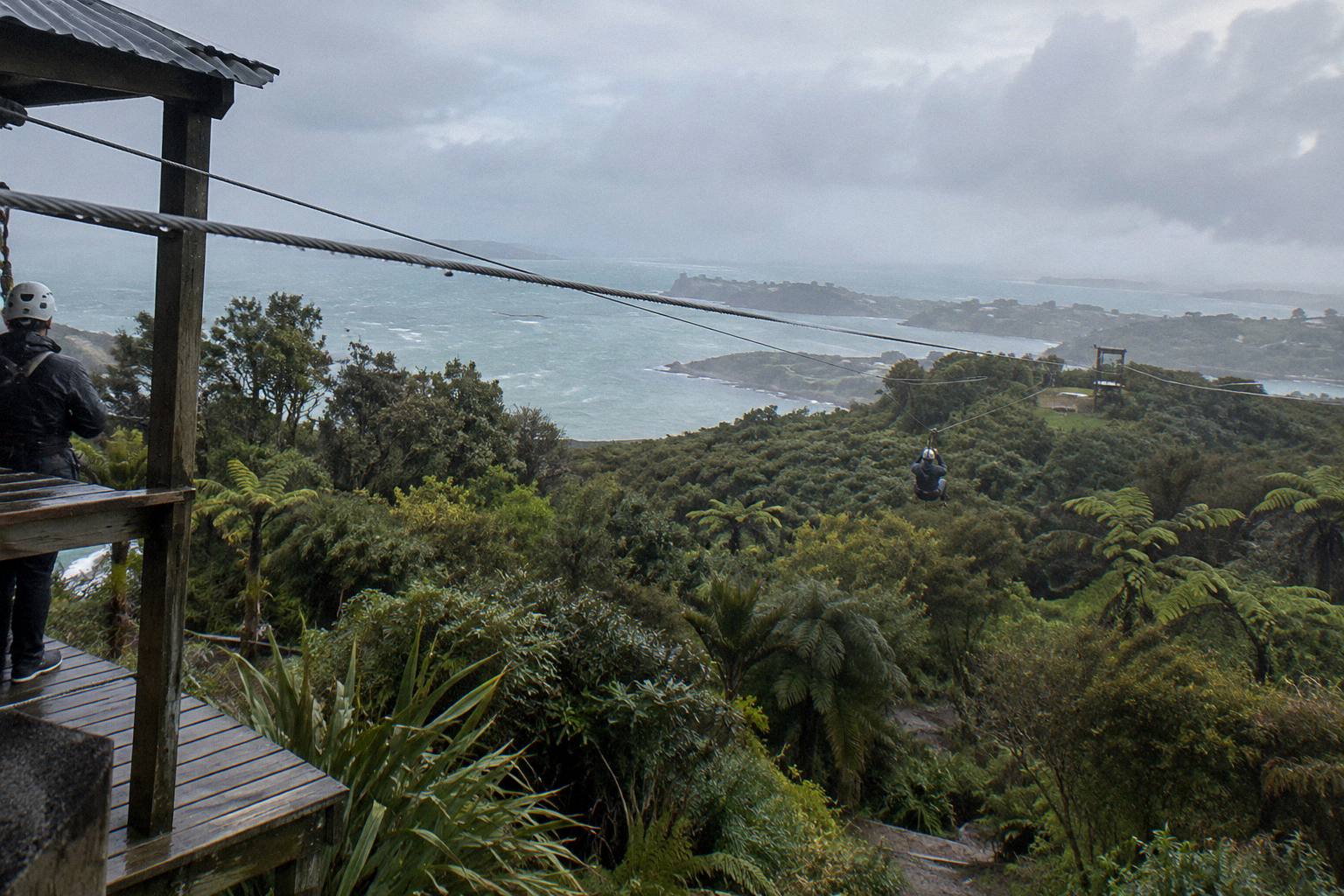
If your slot is cancelled for wind, you are not left arguing about it: the operator's terms promise a reschedule or a full refund. If you cancel yourself, the direct-booking terms are stricter than the platform listings, with charges applying inside 48 hours, so read the cancellation terms on whichever listing you book through rather than assuming one policy fits both channels. Our page on Waiheke zipline weather, wind and cancellations unpacks the full policy.
| Weather or gear question | EcoZip position |
|---|---|
| Does it run in rain? | Yes, rain alone is not a cutoff |
| Wind cutoff | Cancellation when wind is consistently above 35 knots |
| If the operator cancels | Date or time change, or a full refund |
| Loan gear | Small stock of wet-weather gear; bring your own jacket |
| Footwear | Closed, laced or buckled shoes required; no jandals |
| Phones and cameras | Must be strapped to clothing or harness; free phone bungees at check-in |
Seasonally, Waiheke's climate is mild, with average daytime highs around 23 °C in February and 15 °C in July, so cold-weather riding is rare but possible in winter months. July is also the wettest month on 30-year averages at around 123 mm of rain, while January is the driest at around 71 mm, none of which changes the operator's position: rain does not stop the lines, wind does. If you are booking well ahead and want the best odds of calm, clear conditions, our guide to the best time of year for a Waiheke zipline works through the seasons in detail.
How Does Waiheke Compare With New Zealand's Other Zipline Courses?
Waiheke's EcoZip course is modest by national standards: three lines of roughly 200-220 m against Christchurch's 1.1 km Long Ride, with a 125 kg weight ceiling matching Ziptrek Queenstown and slightly above Rotorua Canopy Tours' 120 kg. All New Zealand operators sit under the same WorkSafe adventure activities regime, so the regulatory floor is national, not island-specific.
The comparison matters for a safety-conscious reader because line length and speed are the variables riders feel most. Rotorua Canopy Tours' Original tour runs six ziplines totalling 600 m at up to 50 km/h, while its Ultimate tour stretches to 1.2 km with a 400 m tandem line at up to 80 km/h. Christchurch Adventure Park's Signature Tour totals 2.87 km across four lines and includes New Zealand's highest line. EcoZip's three flights top out around 50-60 km/h, which puts Waiheke on the gentler end of the national spectrum without diluting the thrill of flying side by side above the forest canopy.
| New Zealand course | Total zipline length | Top speed | Max rider weight |
|---|---|---|---|
| EcoZip Adventures, Waiheke | 3 lines, each about 200-220 m | Around 50-60 km/h | 125 kg |
| Rotorua Canopy Tours, Original | 600 m across 6 lines | Up to 50 km/h | 120 kg |
| Rotorua Canopy Tours, Ultimate | 1.2 km across multiple lines | Up to 80 km/h | 120 kg |
| Coromandel Zipline Tours, Driving Creek | About 705 m across 8 lines | Not stated in verified material | 120 kg |
| Christchurch Adventure Park, Long Ride | 1.1 km single line | Not stated in verified material | Not stated in verified material |
Age policies vary more than weight policies across the country. Rotorua Canopy Tours sets a minimum of 6 years on its Original tour and 10 on its Ultimate, Zipline Christchurch has no minimum age but requires riders over 122 cm tall, and EcoZip sets no age limit at all, relying instead on guardian consent and the physical requirements of the harness and the forest walk. None of these approaches is inherently safer than another; they reflect different courses, different walks and different forest terrain. For a fuller matchup, see our comparison of ziplining on Waiheke versus Rotorua Canopy Tours.
What Should Nervous First-Timers Know Before Booking?
The honest answer for nervous riders is that the fear is normal, the systems are layered and audited, and the parts that unsettle people most, height and speed, are exactly the parts the braking and briefing architecture manages. EcoZip's dual lines let two people fly side by side, which many first-timers find steadying, and speeds top out around 50-60 km/h rather than the extremes longer courses reach.
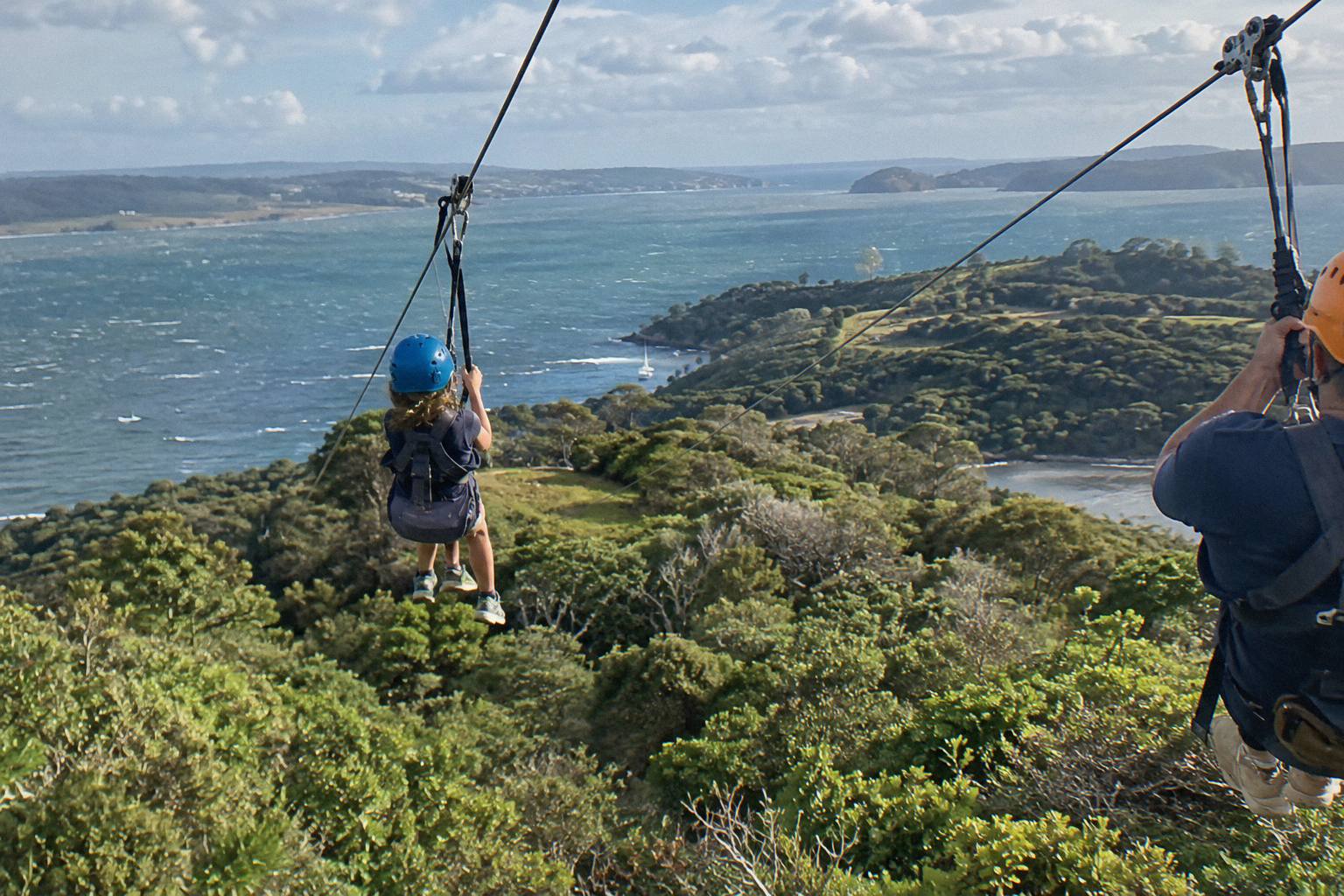
New Zealand operators routinely fly guests into their 80s and 90s, with Rotorua Canopy Tours reporting riders up to 93 years old, because capability matters more than age. Waiheke's EcoZip course has no upper age limit at all, and its three lines of roughly 200-220 m each are modest by national standards: Christchurch Adventure Park's Long Ride alone is 1.1 km. If severe acrophobia is in play, operators themselves advise reconsidering or consulting a doctor first, since panic at height is a genuine safety factor, not just a comfort one. Our longer treatment lives in the guide for nervous first-timers on the Waiheke zipline.
The flagship product ties all of this together: the Waiheke Island zipline and forest walk runs about 3 hours from Matiatia pickup to drop-off, with the two-guide format, the dual 200 m lines and the guided forest walk in one package. You can compare it against the other courses on the full zipline and forest walk listing, or check availability for your dates.
So, Is The Waiheke Zipline Safe?
On the evidence available: the flagship operator is legally registered, externally audited under the national adventure activities regime, uses redundant braking, inspects hardware on three nested schedules, and filters riders through clear weight and health rules. Ziplining is still not risk-free, no Waiheke incident record exists to cite in either direction, and your own compliance with the briefing and the weight range is part of the safety system.
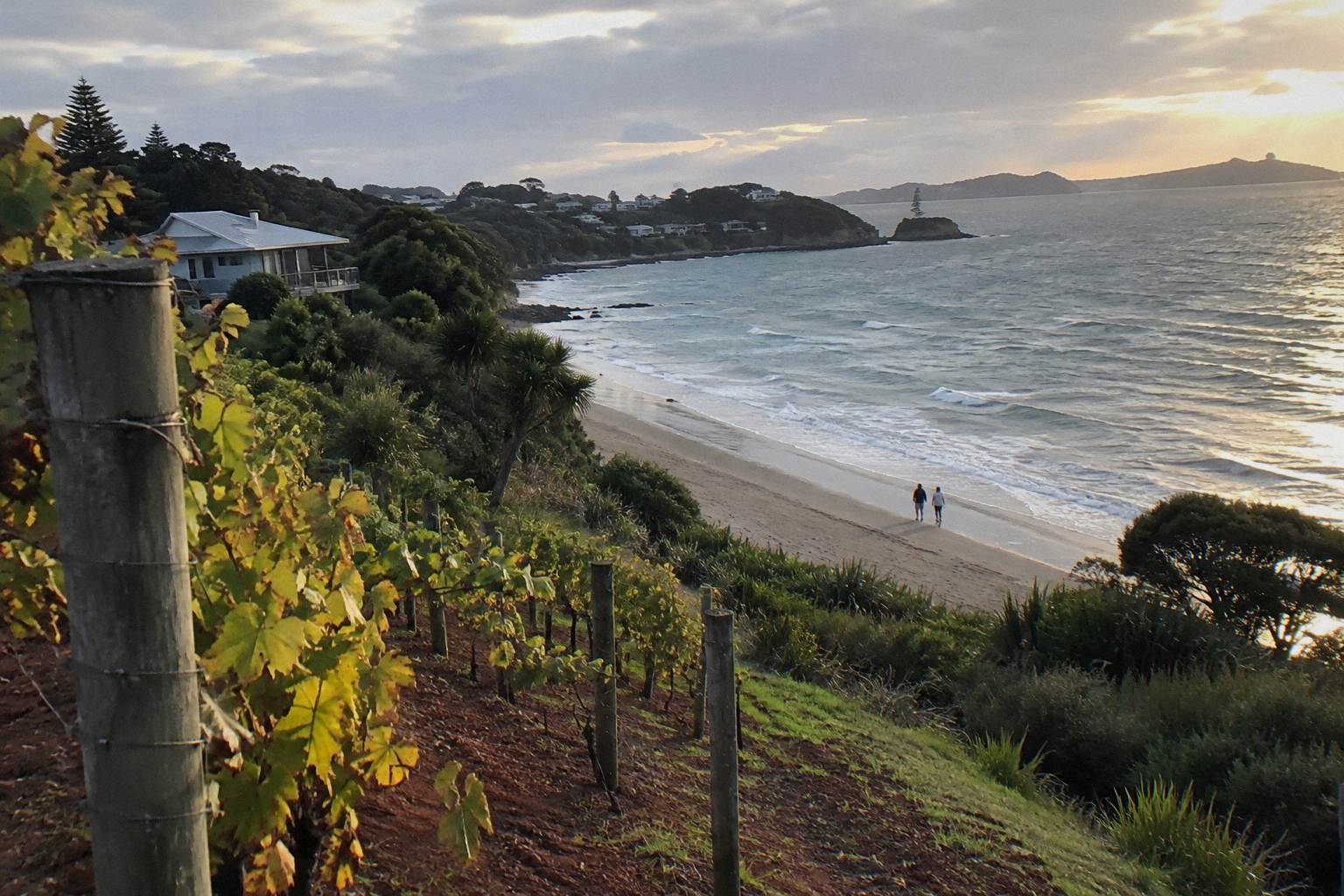
That is as far as an honest publisher can go. The accreditation chain from WorkSafe through AdventureMark to the operator is documentable, and this page has linked the primary sources so you can follow it yourself. What no page can honestly do is promise you an injury-free flight, because the US injury literature is unambiguous that this activity hurts people occasionally, mostly through falls. The decision that remains yours is whether layered, audited risk reduction is enough for your trip, and for the great majority of riders who meet the physical rules and follow the briefing, the Waiheke courses deliver exactly what they advertise: three flights, a forest walk, and a story to tell.
If the zipline is one pillar of a bigger island day, pairing it with a wine afternoon is the classic move, and our guide to vineyards that pair with a Waiheke zipline day maps the logistics from the free post-tour vineyard drop-offs.
Whichever course you lean toward, these are the three zipline experiences worth comparing side by side before you commit.
Common Questions About Waiheke Zipline Safety
Is The Waiheke Zipline Safe?
The flagship operator, EcoZip Adventures, is WorkSafe-registered and AdventureMark accredited, uses ZipStop braking with backups, and inspects hardware daily, weekly and monthly. Ziplining still carries real risk, and no Waiheke incident record has been published either way.
Is The Waiheke Zipline Safe For Beginners?
Yes, structurally: two guides per twelve guests, dual side-by-side lines, speeds around 50-60 km/h, and lines of roughly 200 m. Severe acrophobia is the one condition operators themselves flag as a reason to reconsider or consult a doctor.
What Are The Weight Rules On The Waiheke Zipline?
EcoZip requires riders to weigh between 30 kg and 125 kg, with everyone weighed discreetly at check-in. Being outside the range is not automatically refunded, so check honestly before booking.
Is There An Age Limit For Ziplining On Waiheke?
EcoZip has no age limit, but under-18s need a parent or guardian to agree to the booking terms and sign the risk disclosure form. New Zealand operators elsewhere have flown guests over 90.
Does The Waiheke Zipline Run In The Rain?
Yes. Rain is not a cutoff. EcoZip cancels only when wind is consistently above 35 knots, and then offers a date or time change or a full refund.
Who Should Not Go Zip Lining On Waiheke?
EcoZip lists high blood pressure, cardiac conditions, pregnancy, and back or neck injury as conditions that may impair safe participation, and can refuse anyone affected by alcohol or drugs. Declare conditions at booking and consult a doctor where relevant.