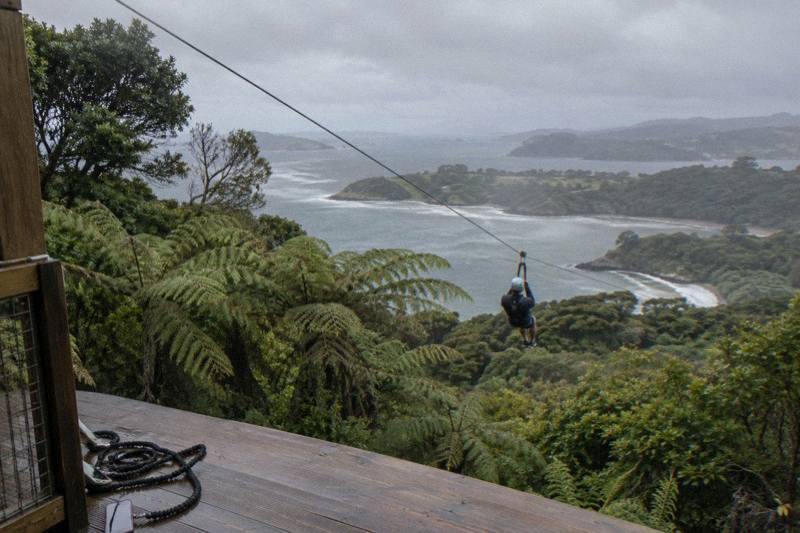
What Happens On A Waiheke Zipline Trip, Step By Step
From the moment your ferry leaves downtown Auckland to the shuttle dropping you at a vineyard, here is the full sequence of a Waiheke Island zipline day, using only the steps the operator itself publishes.
Short answer
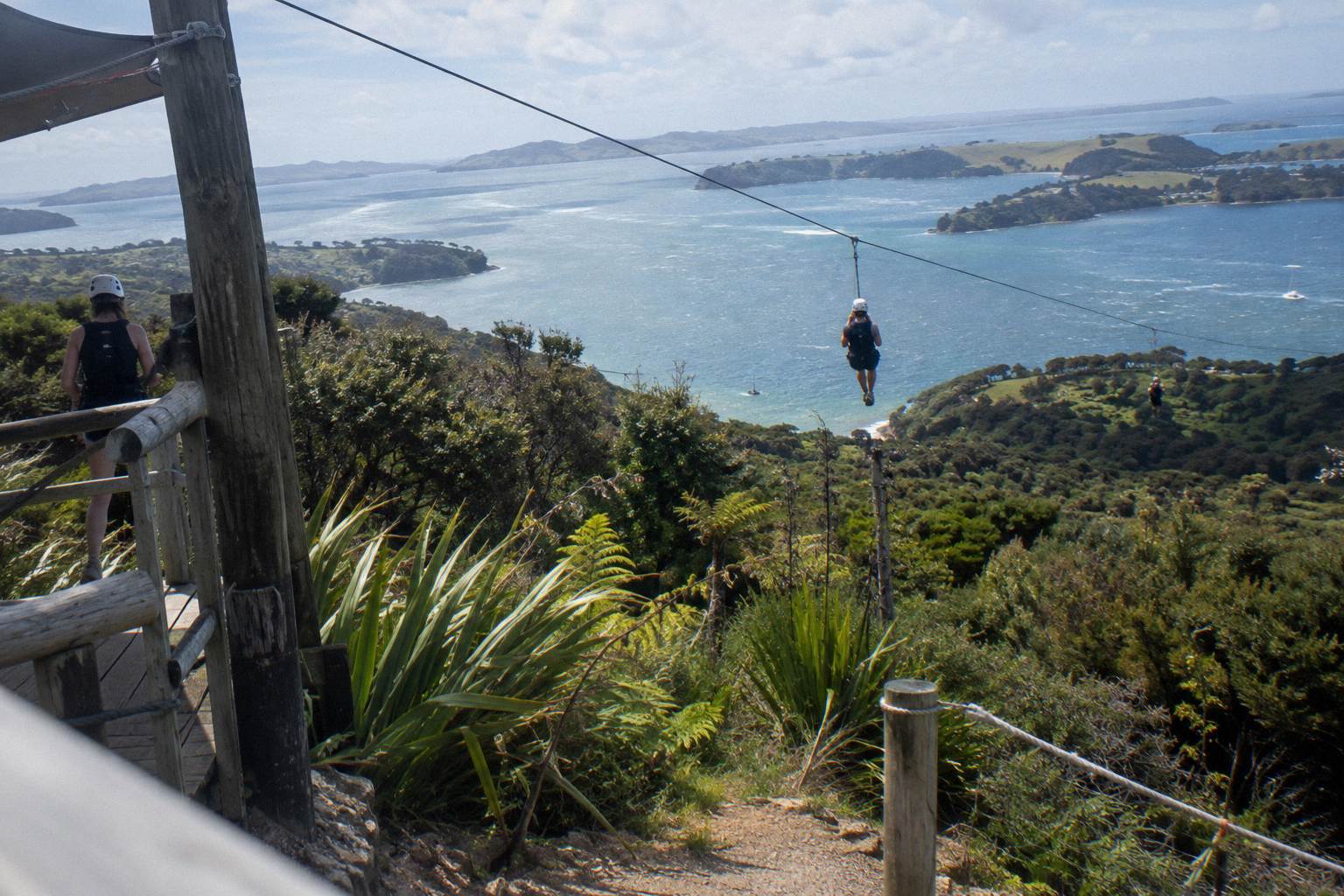
A Waiheke zipline trip runs about 3 hours from Matiatia pick-up to drop-off: discreet weigh-in, harness and helmet fitting, a 20-minute commentated shuttle to Trig Hill, three dual-cable ziplines over 200 m at speeds above 50 km/h, then a guided 1.4-1.5 km native forest walk. Weight limits are 30-125 kg, and the ferry crossing takes about 40 minutes.
Most people booking a Waiheke Island zipline for the first time have one quiet worry: they do not know what they have actually signed up for. The listings say "3 hours, three lines, forest walk," and that is true, but it does not tell you when you get weighed, whether you have to walk back up the hill, or what happens to your phone. This guide walks the day end to end, using only the steps EcoZip Adventures itself publishes, so nothing below is guesswork or folklore from a comments section.
The value of knowing the sequence in advance is real rather than cosmetic. Every stage of this trip has a rule attached to it, from the shoes on your feet at check-in to the drop-off choice you make before you board the shuttle, and the people who enjoy the day most tend to be the ones who arrived already knowing what came next. Nervous flyers calm down noticeably once the unknowns are removed, and confident flyers simply plan better around them. Either way, the sequence below is the whole product, step by step, in the order you will actually live it.
Getting There: The Ferry From Auckland To Matiatia
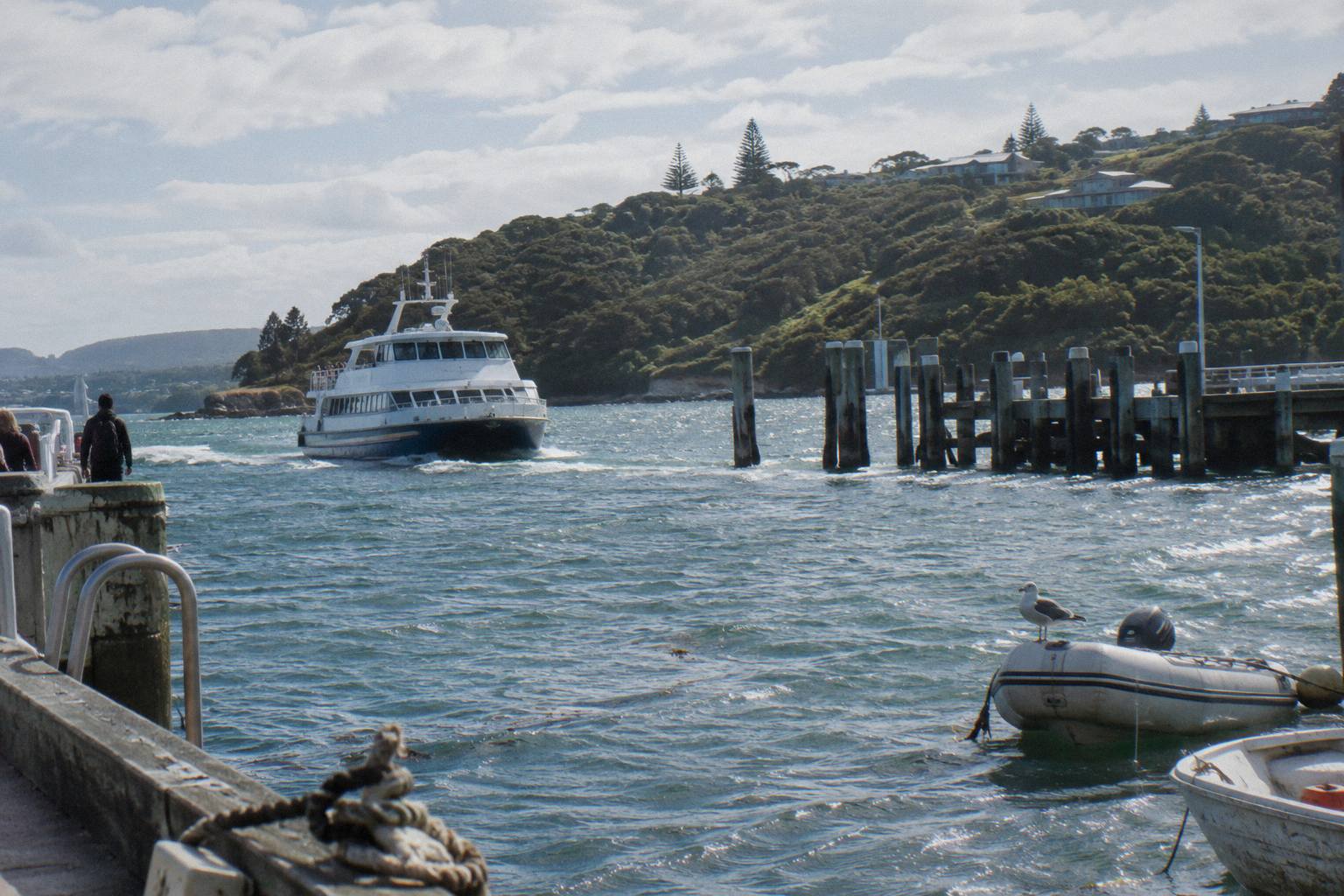
The trip starts at the Downtown Ferry Terminal on Quay Street in central Auckland, where the Fullers360 passenger ferry leaves for Matiatia on Waiheke, a crossing of about 40 to 45 minutes on direct sailings. EcoZip's day begins at Matiatia itself, so the ferry you pick determines how relaxed the whole morning feels. Nothing about the zipline happens in Auckland.
Some services call at Devonport and run about ten minutes longer. Fullers runs the route year-round with sailings typically every 30 to 60 minutes, and more often at peak times, so the timetable is generous but seasonal, and exact departure times should be read on the operator's own ferry page rather than trusted to memory. First sailings on weekdays start around 6:00 am in the shoulder season and around 7:00 am on weekends and holidays, with late services running to nearly midnight, so even a late ferry home is usually possible after a vineyard lunch. The EcoZip price does not include the ferry ticket, which catches some people out: budget for it separately or pick a combo product that bundles the crossing.
Waiheke sits about 17.7 km from downtown Auckland across the Hauraki Gulf, and on a clear morning the crossing is genuinely part of the experience rather than a commute, with the island's western ridgeline appearing well before you dock. Cruise ship passengers use exactly the same passenger ferries from the downtown terminal, so the logistics are identical whether you are staying in the city or disembarking from a ship, a scenario our Waiheke zipline guide for cruise ship passengers covers in detail.
A practical note on timing. If you are starting from downtown Auckland, treat the ferry as your hard deadline for the day. A missed sailing usually means a missed zipline slot, and same-day rebooking depends on availability. The simplest structure is a ferry that lands at Matiatia at least 30 minutes before your EcoZip check-in time, which gives room for a coffee at the wharf and a toilet stop before the harness goes on. Matiatia itself is a compact terminus, with the EcoZip meeting point an easy walk from where the ferry berths.
If you are weighing up how the Waiheke options compare with the mainland, our piece on zipline Waiheke versus Auckland and Coromandel covers that trade-off, and the ferry logistics are laid out in detail in catching the ferry to Matiatia for a morning zipline slot.
Check-In At Matiatia: Weighing, Harness And Helmet
Check-in at Matiatia is where the trip becomes physical: you are weighed discreetly, fitted with a harness and helmet, and briefed on the weight rules, which require at least 30 kg and no more than 125 kg per rider. The weighing is private and quick, done at check-in rather than in front of the group, and it exists because the braking systems and trolleys are rated for that range.
The operator states plainly that being over or under the limit is not automatically refunded, so if you are close to the boundary it is worth reading the rules before you travel rather than discovering them at the wharf. There is no age limit at all: under-18s need a parent or guardian to agree to the booking terms and sign the Risk Disclosure Form, which makes the trip genuinely multi-generational. Children priced as children are 15 and under, and the family rate covers 2 adults plus 2 children, or 1 adult plus 3 children. The under-18 sign-off can be handled by a guardian agreeing to the booking terms, so a school group or a grandparent-led family is not blocked by paperwork.
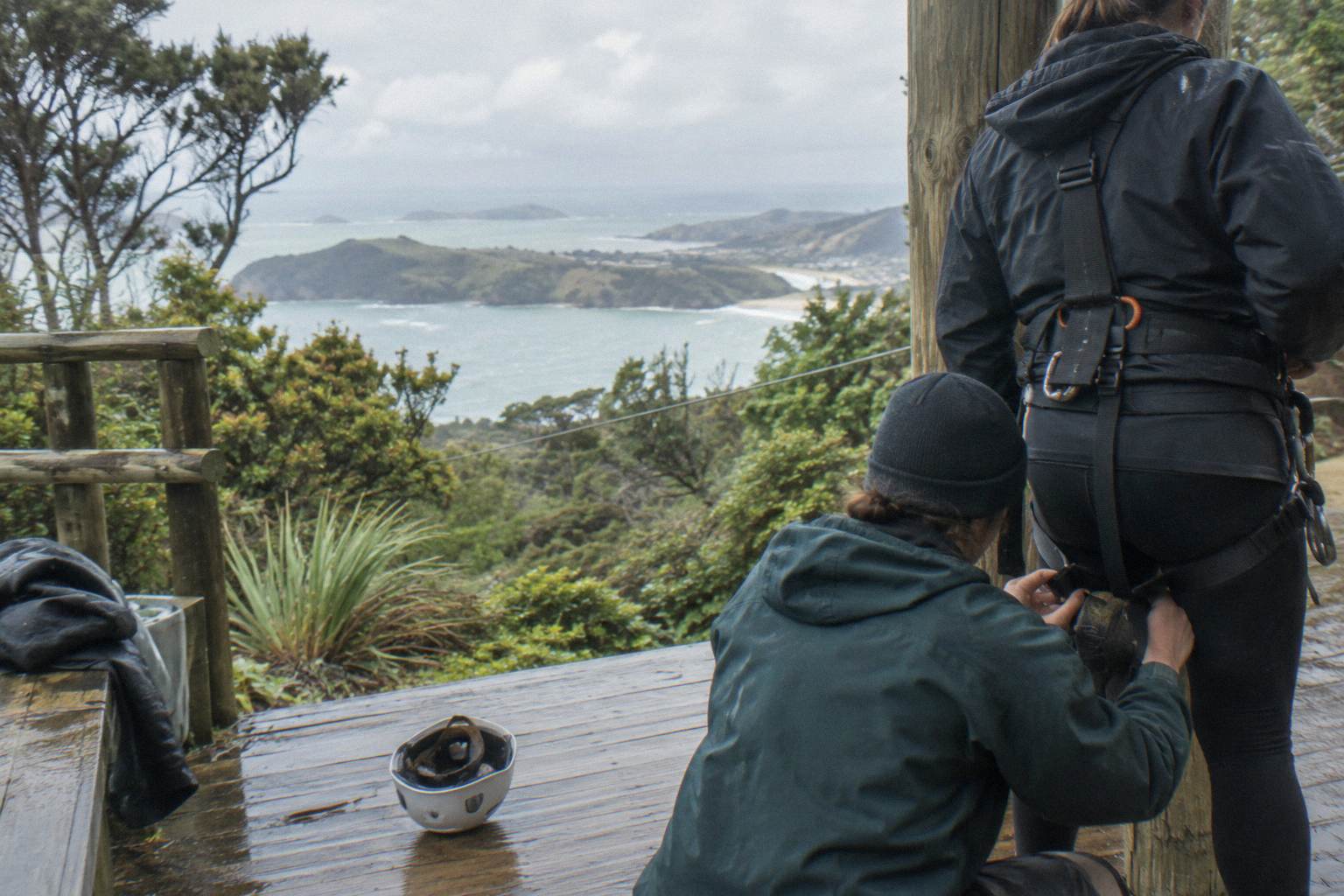
Once cleared, the harness goes on over your clothes and the helmet over your head, and the guides check every fitting themselves. You are also handed a free phone bungee at check-in, a small cord that tethers your phone to your clothing or harness. Phones and cameras must be strapped down before you fly: an unsecured phone at 50 km/h becomes a projectile, and the operator's rule is that loose devices simply do not go up the hill. The briefing that follows covers hand positions, the braking and landing posture, and the one instruction repeated more than any other, which is never to grab the cable with your hands.
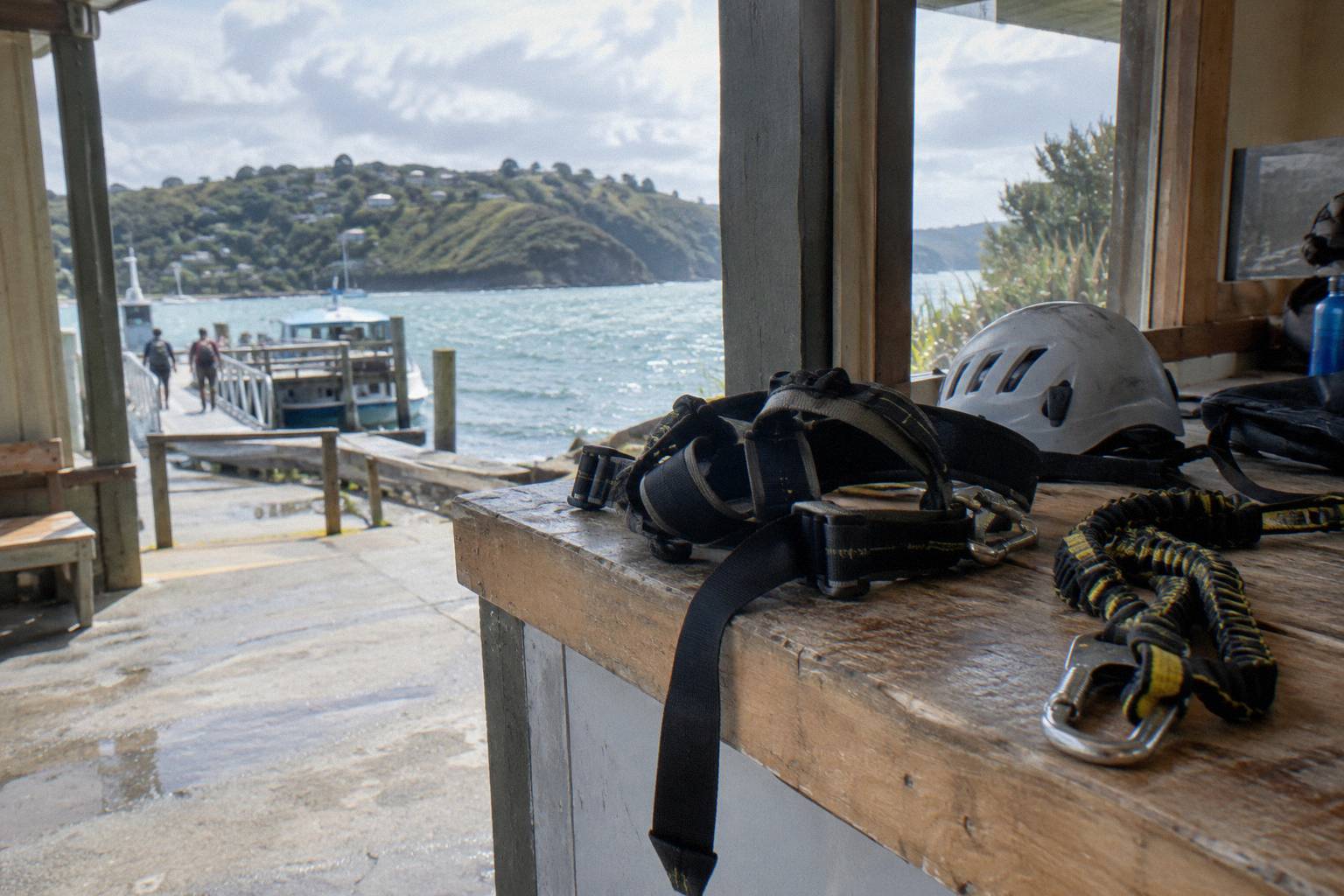
| Step | What happens | What you need to do |
|---|---|---|
| Arrive at Matiatia | Meet the EcoZip team near the ferry terminal | Bring your booking confirmation and closed shoes |
| Discreet weigh-in | Weight checked privately against the 30-125 kg range | Answer honestly; the number is not announced |
| Guardian sign-off | Under-18s need a parent or guardian to sign the Risk Disclosure Form | A guardian must be present or have agreed to the terms |
| Harness and helmet | Guides fit and check every harness and helmet | Wear weather-appropriate clothing underneath |
| Phone bungee | Free tether handed out for phones and cameras | Strap devices to clothing or harness before flying |
The weighing itself is the step people ask about most, and the honest answer is that it is unremarkable: a discreet scale, a nod, and you move on. It is worth being straight with the number, though, because the weight range exists for the physics of the braking system rather than for appearance, a rider too light may not carry enough momentum to reach the landing platform reliably, and a rider too heavy arrives with more energy than the brake is rated to absorb. The full weight and harness detail, including what happens near the limits, is in our dedicated guide to the Waiheke zipline weight limit and harness sizes.
The Shuttle Ride To Trig Hill
From Matiatia the group boards the EcoZip minivan for a 20-minute commentated ride to Trig Hill, the launch site about 15 minutes from the ferry terminal as the crow flies but longer by road. The shuttle doubles as a mini tour of Waiheke's highlights, with the driver pointing out beaches, vineyards and viewpoints on the way.
The commentary is optional in the sense that you can tune out, but the ride is not. Everyone in the group travels together, up to 12 people with 2 guides, and the vehicle drops you at the top of the course. This matters for one practical reason: you start high and finish low. Unlike some courses where you climb stairs between lines, the Waiheke layout sends you downhill through the forest, with the guided walk as the return leg rather than a stair climb. For anyone who has done a zipline elsewhere and remembers the uphill slogs between platforms, that downhill design is quietly the best structural feature of this course.
The 20 minutes in the van are also when the guides size up the group, answer first-timer questions and set the tone, and it is worth using them: ask about the lines, about where to look, about what the landing feels like. Groups that chat on the shuttle are visibly looser on the first platform than groups that sit in silence scrolling. It is a small thing, but on a product built around side-by-side flying, the social warm-up genuinely changes the experience.
Bookers driving themselves should know that EcoZip also allows arriving at Trig Hill directly, in which case the on-site portion runs about 2 hours instead of the roughly 3-hour ferry-to-drop-off experience. Most visitors, though, come across on the ferry and take the shuttle, and the pick-up choices when booking direct include Matiatia, Oneroa village, or Bus Stop 7, the Explorer hop-on hop-off interchange. That last option matters if you are pairing the zipline with a day of bus hopping, which we cover in using the Waiheke hop-on hop-off bus with a zipline trip. Oneroa pick-up suits anyone staying overnight in the island's largest village, roughly 2 km from the wharf, with its cafes and beaches.
The Three Ziplines, One By One
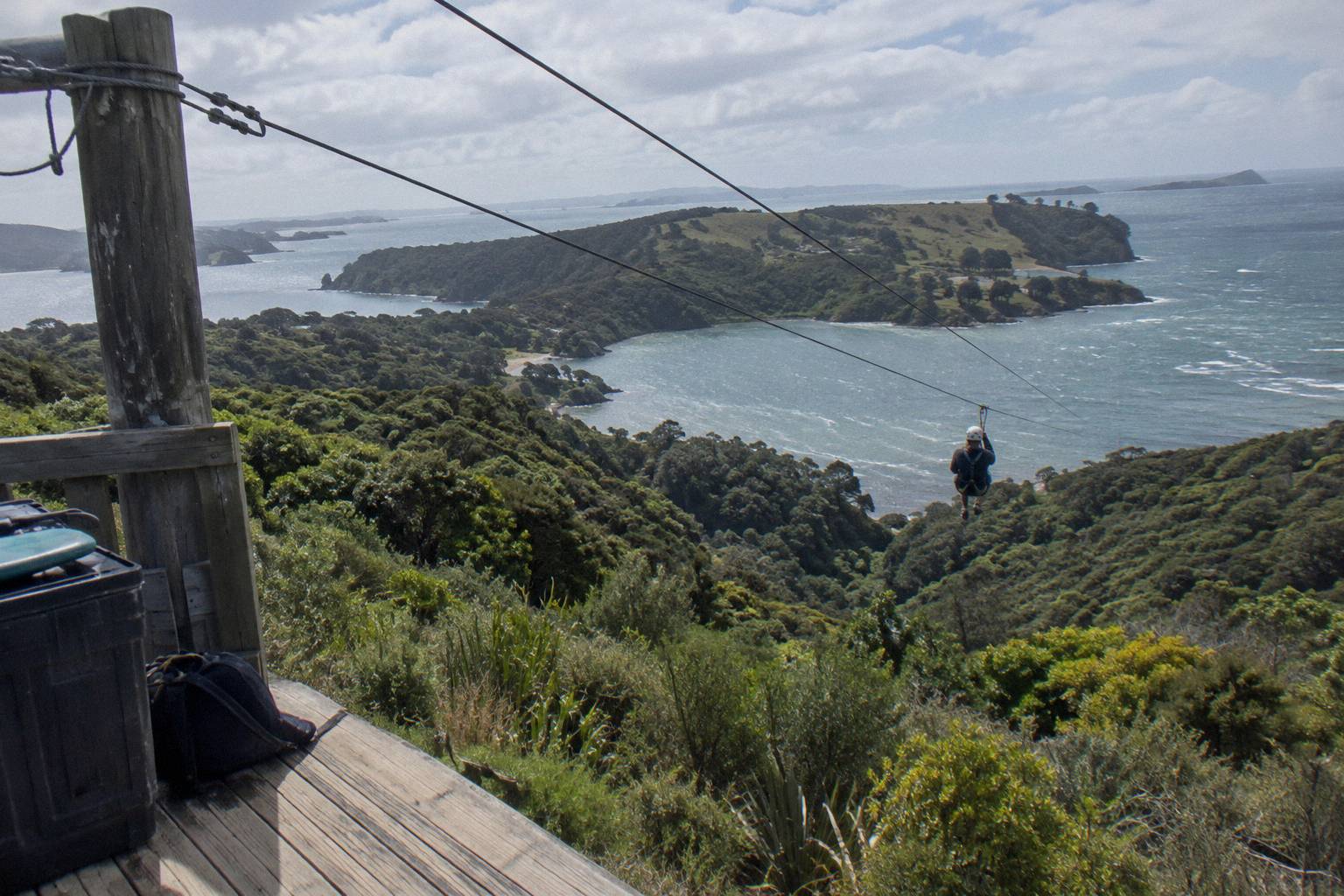
The flying itself is three dual-cable ziplines, each over 200 m, flown side by side so two riders launch together: the Vineyard Cruise, then City View, then the Kurinui, the longest at 220 m, with speeds above 50 km/h on the faster lines. Dual cables are the defining feature of this course: you launch next to your companion and land next to them.
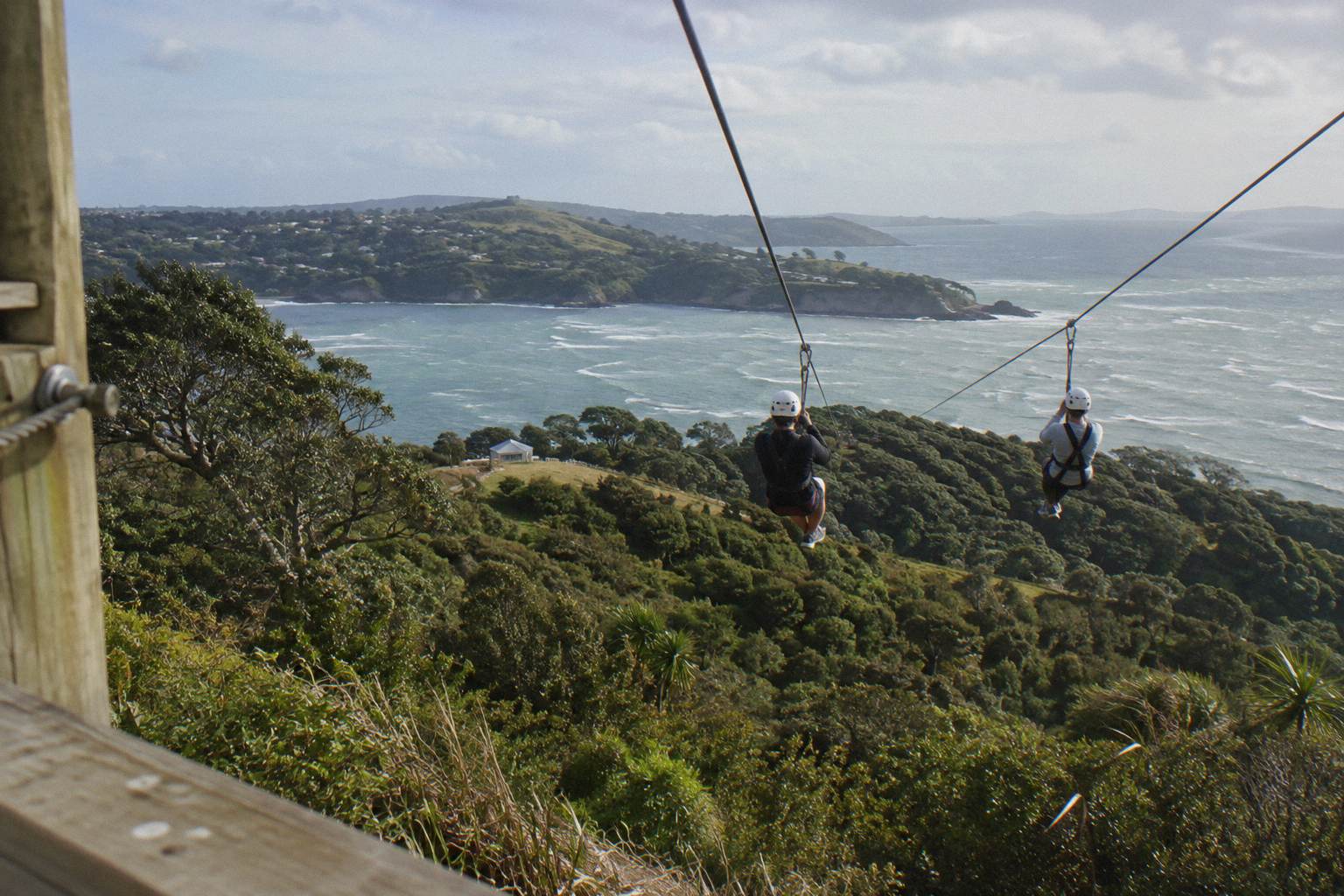
The sequence is deliberately graded. The Vineyard Cruise opens the session and lets you learn the body position over vineyard country, the City View line adds the Auckland skyline across the water, and the Kurinui, at 220 m, is the one people talk about afterwards, fast enough to pass 50 km/h for a rider of average weight. Braking is handled by the course, not by you: EcoZip uses ZipStop self-braking trolleys with backup systems, and the hardware is inspected on daily, weekly and monthly cycles as part of the operator's AdventureMark accreditation, held through Quality Standards International since 2012. The accreditation scheme sits under New Zealand's adventure activity safety regulations, and AdventureMark's certification page explains what that audit covers.
What you actually do on each line is small: stand on the platform, listen to the guide's launch call, sit back into the harness, and keep your hands where the briefing told you. Grabbing the cable with your hands is the classic beginner error and the one every safety briefing spends the most time on, because skin does not win against moving steel. Feet and legs take the landing position the guides demonstrate. Between lines there is walking of only a few minutes on paths and platforms, and the pace is set by the guides rather than the clock, so nobody is rushed and nobody is left waiting long.
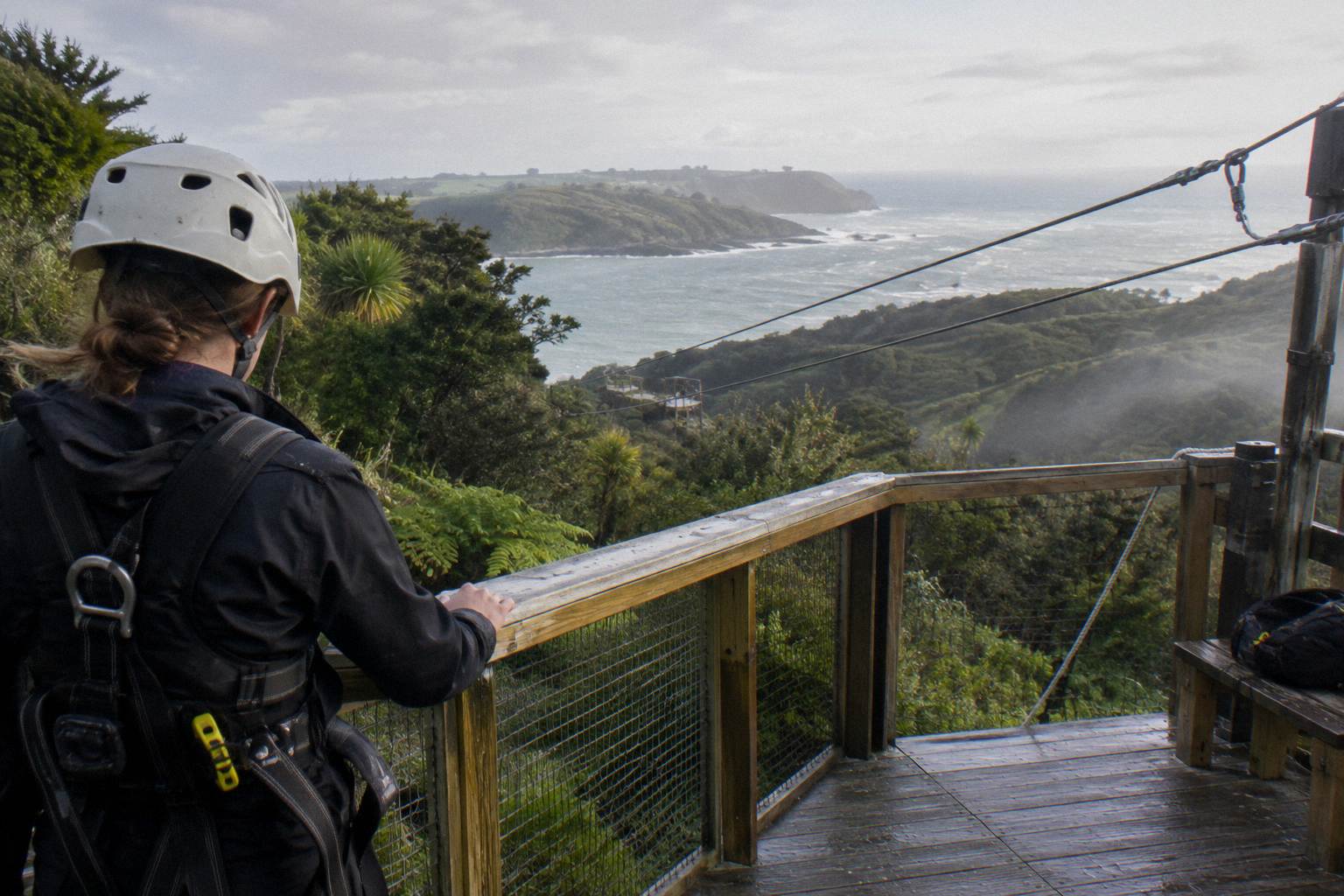
For nervous flyers, the graded structure does a lot of quiet work. The first line is the teaching line, the second adds the view, and by the third most first-timers are laughing rather than gripping, which is precisely why the order is fixed. Riders who want to fly with a specific person, a parent and child, two friends, should say so before the first launch, because the pairing carries through the set and the guides will arrange the queue accordingly.
| Line | Approx. length | What you fly over | Notes |
|---|---|---|---|
| Vineyard Cruise | Over 200 m | Vineyard slopes | The opener; learn body position here |
| City View | Over 200 m | Forest with Auckland skyline across the water | Views north to the city |
| Kurinui | 220 m | Native forest valley | Longest line, speeds above 50 km/h |
If side-by-side flying is specifically what sold you, note that Man O' War's Forest Flight takes a different shape: three tandem lines totalling over 900 m, connected by a 660 m elevated boardwalk through kauri forest, starting with a scenic drive to a 210 m viewpoint and finishing steps from a beachfront tasting room. The comparison, including which format suits which traveller, is set out in Man O' War Forest Flight versus EcoZip on Waiheke. In short, EcoZip gives you the dual side-by-side cables and the return forest walk, while Man O' War gives you longer total cable, more boardwalk, and a vineyard finish.
The Guided Forest Walk: The Return Leg
After the third line the trip continues on foot: a guided native forest walk of about 1.4 to 1.5 km back through the bush, on an uneven track with switchbacks, a few steady uphill stretches and possible mud after rain. The walk is compulsory, even though the guided commentary on it is optional, and it needs reasonable fitness.
This is the part of the day that surprises people who pictured a pure adrenaline product. You have just flown 600-plus metres of cable over the canopy, and now you spend the walk underneath it, with a guide pointing out native species and the conservation story of the block. The switchbacks control the gradient rather than eliminating it, and after rain the surface holds water in patches, so the shoe rule from check-in earns its keep here. Closed, laced or buckled shoes are required, no jandals, and that rule is really about this track as much as the platforms.
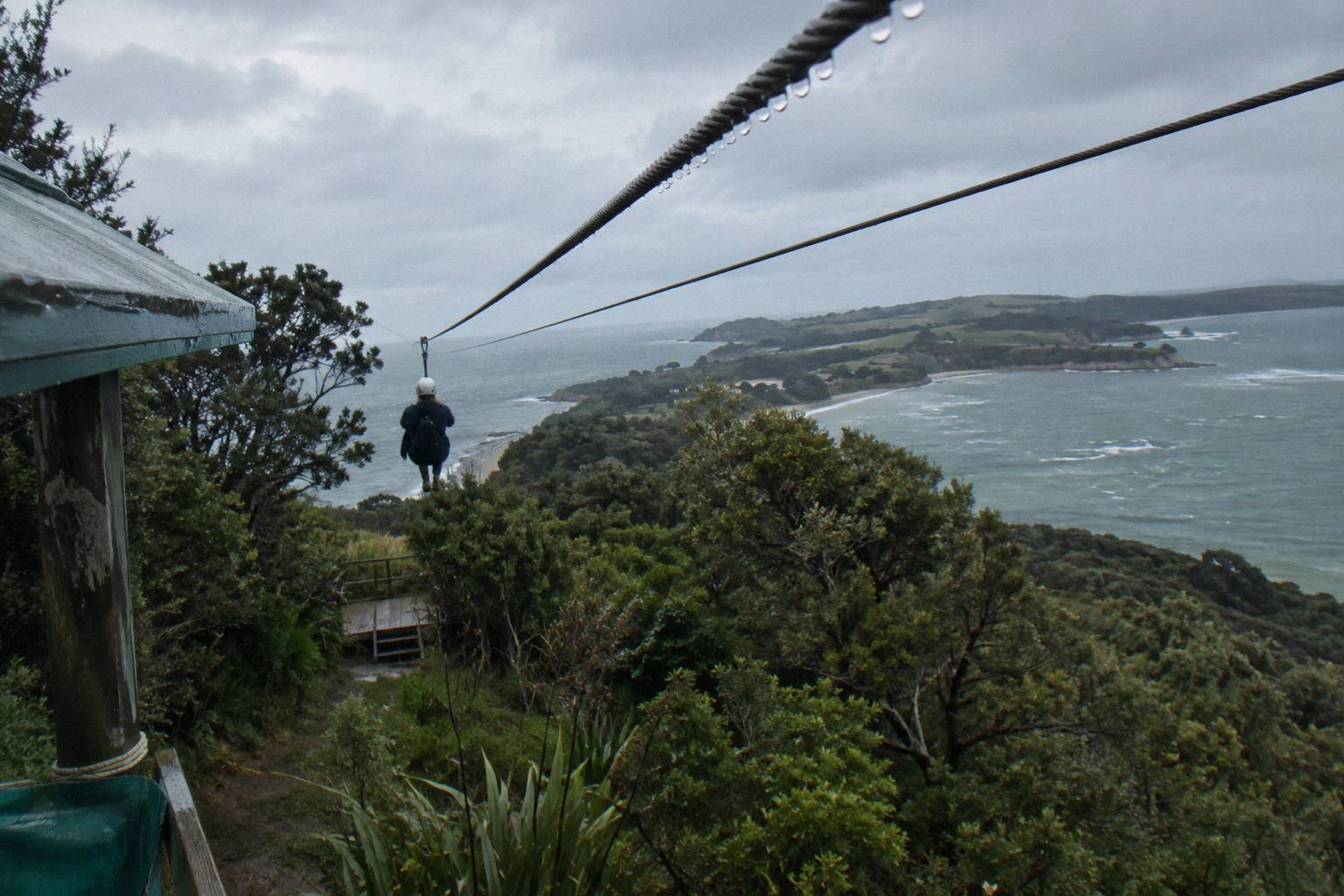
Practically, the walk sets the fitness floor for the whole trip. If a 1.5 km undulating bush walk with a few climbs is manageable, the day is manageable; if it is not, that is the honest signal, and the operator's accessibility page is the place to check the specifics, which our guide to Waiheke zipline accessibility and mobility works through. Weather changes the track too: the operator runs in rain and keeps only a small stock of loan wet-weather gear, so bringing your own jacket is the standing advice, which is expanded in what to wear ziplining on Waiheke.
The walk also serves a recovery purpose that first-timers appreciate only in hindsight. The ziplines are over in a rush of minutes, and the forest walk gives the morning a second act, slower and quieter, where the adrenaline drains off and the island gets to show its non-thrill side. Many reviews of the overall experience single out the bush section as the part people did not expect to enjoy, and the guides' conservation commentary is the reason: it reframes the course from an amusement into a piece of managed native forest you have just flown across.
Drop-Off Options: Where The Trip Actually Ends
The default ending is back at Matiatia, but EcoZip also offers a free post-trip drop-off at a list of vineyards and restaurants, including Stonyridge, Te Motu, Wild Estate, Tantalus, Postage Stamp, The Heke and Soho, or a shuttle link onwards. This turns the last part of the trip into a genuine fork in the road: ferry straight back, or lunch with the afternoon ahead of you.
For a day-tripper on the 9-hour zipline, wine and vineyard lunch combo, the ending is built in. For someone on the standard 3-hour trip, the drop-off choice is the cheapest upgrade on the island: it costs nothing, and it saves the otherwise awkward transfer from Trig Hill-adjacent country to the eastern vineyards. Book it when you book, not on the day, because the shuttle runs to a schedule tied to the trip that just finished.
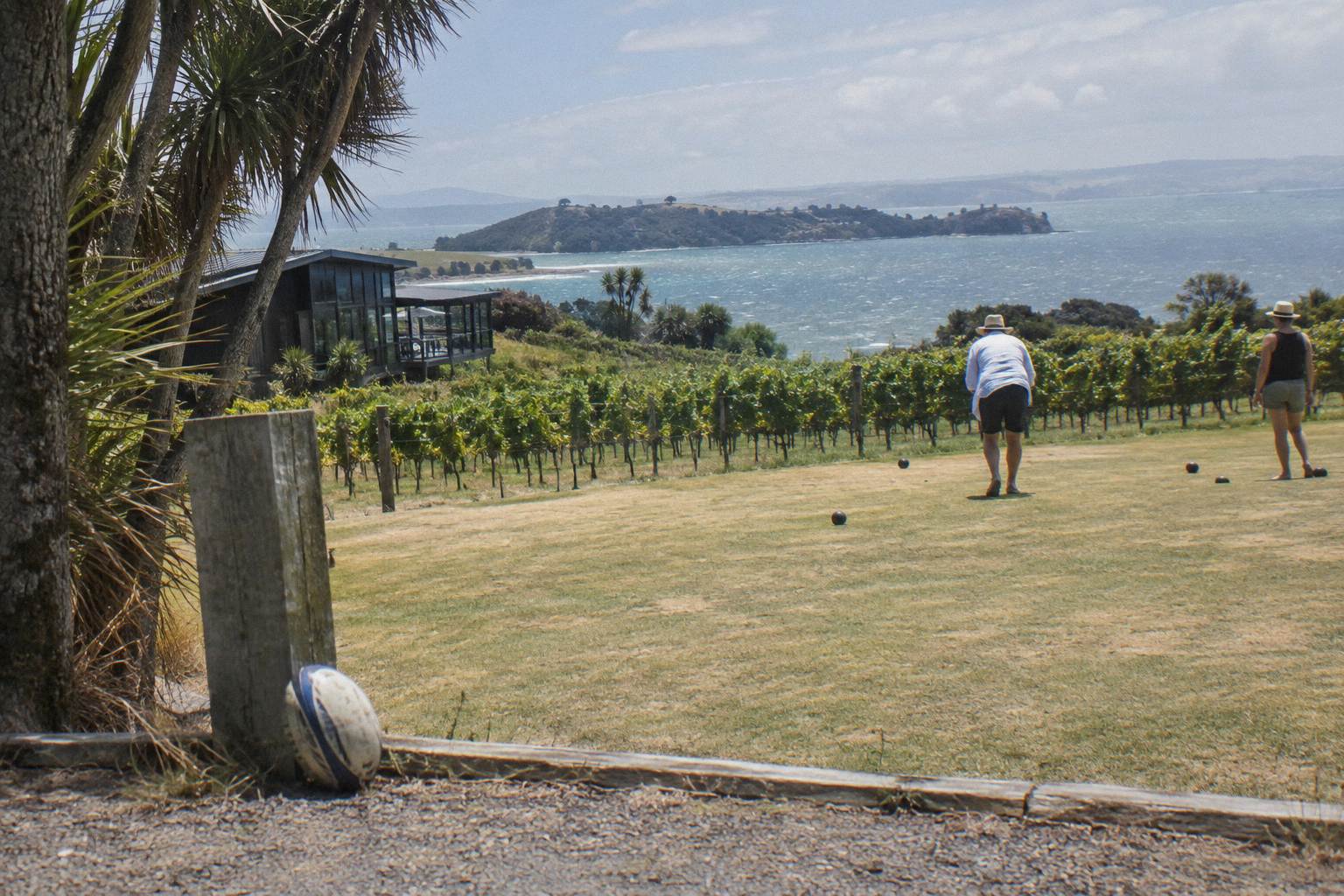
The choice also interacts with your ferry home. A 3-hour morning trip that ends with a vineyard drop-off still leaves an afternoon for a tasting flight and a late lunch before a late sailing, and Fullers runs late services into the evening in the shoulder season, so the constraint is looser than it first appears. The one combination to avoid is a tight afternoon ferry paired with an ambitious drop-off plan: the shuttle will get you to the vineyard, but it will not get you back to the wharf on your schedule, and taxis on the island are thinner than in the city.
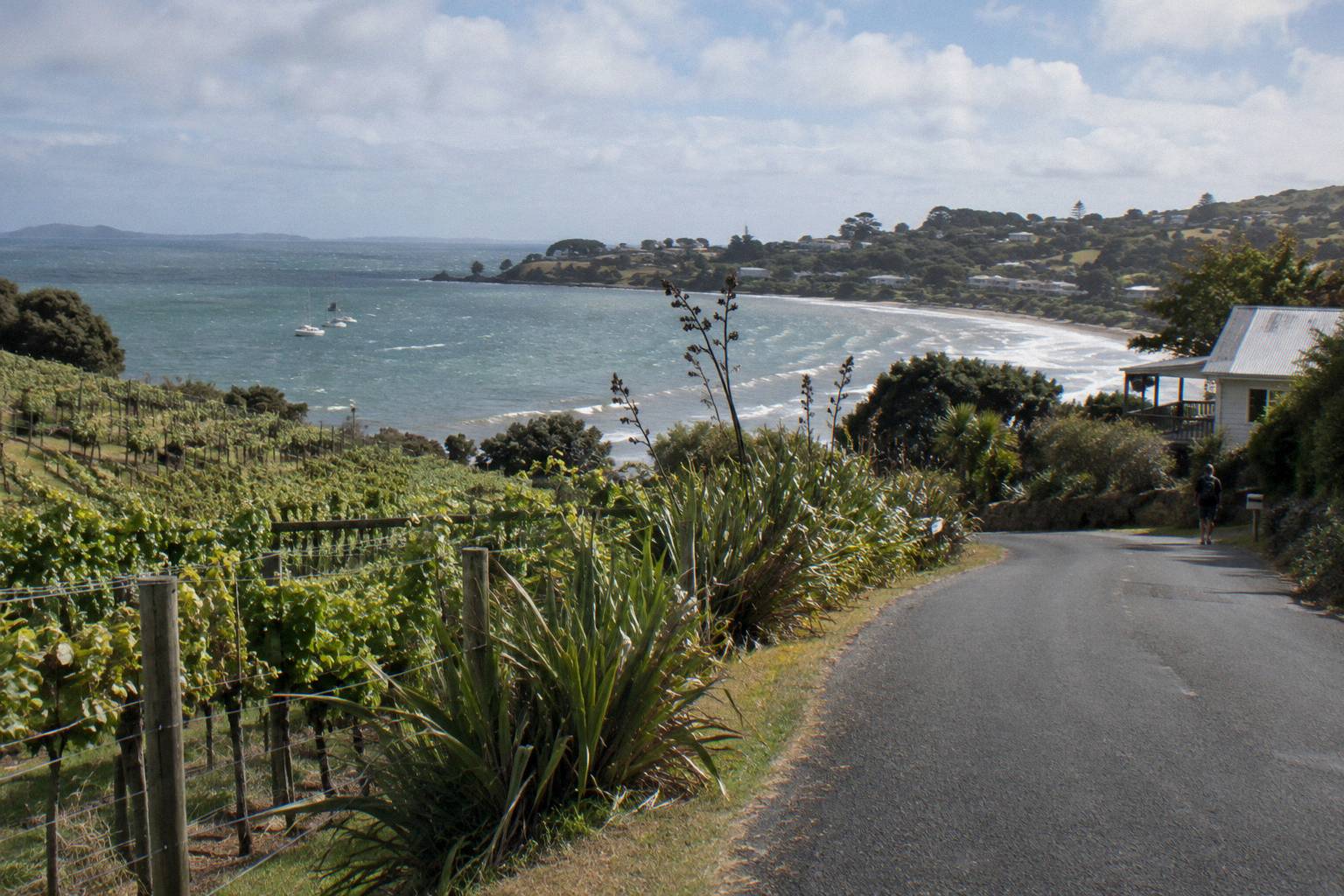
| Ending option | Where you finish | Best for |
|---|---|---|
| Matiatia drop-off | Ferry terminal | Catching a specific ferry back to Auckland |
| Vineyard drop-off | Stonyridge, Te Motu, Wild Estate, Tantalus, Postage Stamp, The Heke or Soho | Lunch or a tasting before the sail home |
| Shuttle link | Connects onward around the island | Staying on Waiheke, or joining another activity |
Which vineyards reward the extra hours is its own question, and Waiheke has around 30 wineries with roughly 20 cellar doors open to the public, tastings typically of 3 to 5 wines with flights commonly in the NZ$20 to NZ$55 range, though fees vary by cellar door and should be checked on the day. Many cellar doors open around 11 am to 5 pm, and bookings are advised for groups. Our guide to vineyards that pair with a Waiheke zipline day does that matching in full, and the lunch question specifically is handled in Waiheke zipline lunch and vineyard stops.
What To Hold, Strap And Wear, Step By Step
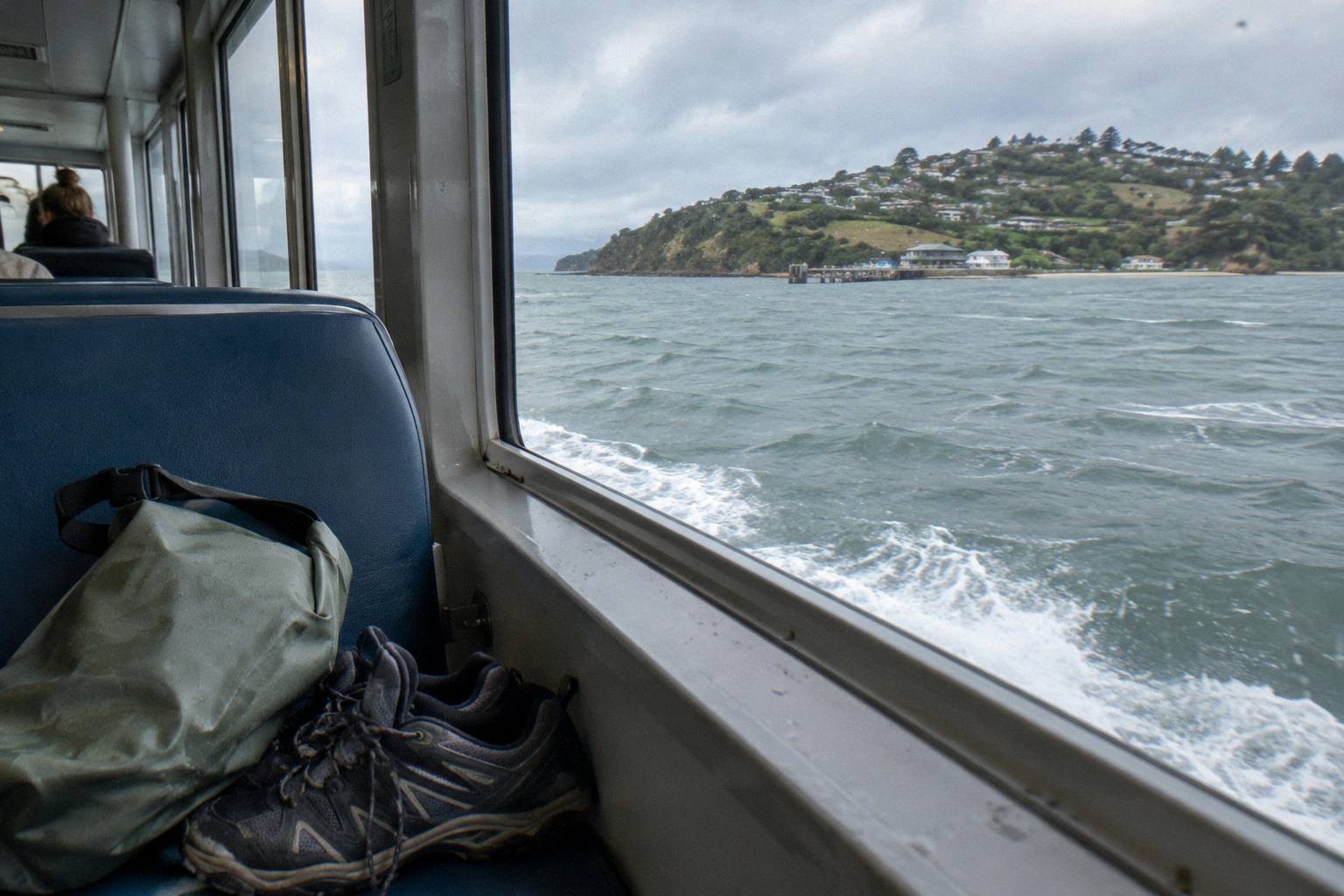
Across every step of the day the equipment rules are the same few lines: closed, laced or buckled shoes, weather-appropriate clothing with a warm layer in cold weather, sunscreen and a hat that fits under a helmet, your own rain jacket, and every phone or camera strapped to clothing or harness with the free bungee provided. None of these are suggestions. Each maps to a specific moment in the day.
| Item | Rule at each step | Why it matters |
|---|---|---|
| Shoes | Closed, laced or buckled, from ferry to forest walk | Uneven, muddy track with uphill stretches |
| Phone or camera | Strapped to clothing or harness at all times | Free phone bungee at check-in; loose devices are projectiles at speed |
| Hat | Must fit under the helmet | Helmets are fitted at check-in before the shuttle |
| Clothing | Weather-appropriate, warm layer in cold weather | Trip runs in rain; only a small stock of loan wet-weather gear |
| Sunscreen | Applied before Trig Hill | Platforms and shuttle are open-air |
The rules are easiest to follow if you pack for them at home rather than at the wharf. Shoes that lace or buckle are the one item that cannot be improvised, since jandals are explicitly excluded and the forest track punishes open toes. A hat that fits under a helmet means a close-fitting cap rather than a wide brim, which will simply not sit under the shell. The warm layer matters even in summer if you are sailing early: the ferry deck and the Trig Hill platforms are exposed, and Waiheke's average daytime highs run from about 15 degrees in July to about 23 in February, with rain spread through the year and July the wettest month at around 123 mm.
Photography deserves its own sentence. Phones are welcome on the lines provided they are tethered, and the free bungee at check-in is exactly for this, but anything not strapped stays in a pocket or a bag, and the guides enforce it without exceptions. Riders who want footage of the flight rather than of their own face should ask a companion on the adjacent cable to fly with the camera, since the side-by-side format gives you a second rider at almost the same speed and angle. Our guide to photos, GoPros and phones on the Waiheke zipline runs through the options.
The health questions follow the same honest pattern. The operator lists conditions that may impair safety, including high blood pressure, cardiac conditions, pregnancy, and back or neck injuries, and it may refuse anyone affected by alcohol or drugs. None of that is unusual for a New Zealand adventure activity operator; it is the standard disclosure regime the sector runs under, and the operator's own FAQ page, at EcoZip's Waiheke FAQs, is the authoritative version. For the wider safety picture, including how New Zealand audits operators like this one, see is the Waiheke zipline safe. Nervous first-timers have their own set of questions, and Waiheke zipline for nervous first-timers answers them step by step through this same sequence.
Common Questions About A Waiheke Zipline Trip
How Long Does The Whole Waiheke Island Zipline Trip Take?
About 3 hours from Matiatia pick-up to drop-off, or about 2 hours on site if you drive yourself to Trig Hill. Add the 40 to 45 minute ferry each way if you are starting in Auckland.
Do You Get Weighed Before Ziplining On Waiheke?
Yes. Everyone is weighed discreetly at check-in against the 30 to 125 kg range, privately rather than in front of the group. Being outside the range is not automatically refunded.
Is The Forest Walk Optional?
No. The guided commentary is optional, but the walk itself, about 1.4 to 1.5 km of uneven track with switchbacks and a few steady uphill stretches, is a compulsory part of the experience.
Can I Bring My Phone On The Ziplines?
Yes, but it must be strapped to your clothing or harness. EcoZip hands out free phone bungees at check-in, and loose devices are not permitted on the lines.
Where Does The Trip Drop You Off?
Back at Matiatia by default, or free at a list of vineyards and restaurants including Stonyridge, Te Motu and Wild Estate, or with a shuttle link onwards around the island.
Does The Zipline Run In The Rain?
Yes, the trip runs in rain. It may be cancelled if wind is consistently above 35 knots, in which case you are offered a date or time change or a full refund.
Planning the day is easier once the sequence is fixed in your head, and Waiheke Zipline Tours exists to keep every step of it documented from primary sources. If the full-day version with lunch and tastings appeals more than the 3-hour core trip, Check availability on the operator's live listing alongside our guide to the Waiheke zipline and wine tasting day tour.